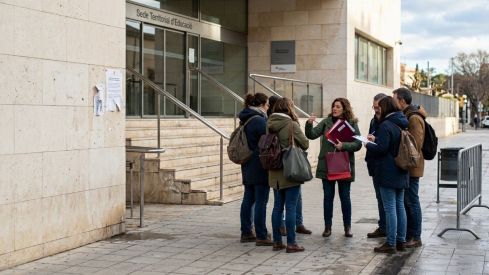
The unions USTEC, Intersindical, and Professors de Secundària have held a meeting with the territorial management of the Department of Education in Tarragona to present their demands before the upcoming strike days.
The meeting takes place in a context of growing labor tension. Teacher representatives seek to pressure the administration to resume negotiations after considering the previous agreements signed by other union organizations insufficient.
Unions reject the majority agreement
Noé Muñiz, spokesperson for USTEC in Tarragona, has frontally questioned the validity of the recently reached agreement. He considers that the text does not achieve significant advances for the teaching staff and criticizes that it was closed with CCOO and UGT, whom he defines as minority unions in the sector.
"We consider that the agreement that has been reached with CCOO and UGT is not valid. It is an agreement in which practically nothing is achieved, which, moreover, is signed with two unions that are in the minority" - Noé Muñiz, spokesperson for USTEC in Tarragona
Muñiz has highlighted that, despite a brief truce in the mobilizations, the mood among the teaching collective remains firm. The generalized perception is that nothing tangible has been achieved, which bodes well for a high turnout in future strike calls.
Concrete demands and rejection of police security
The platforms demand an effective reduction in school ratios, a decrease in bureaucratic burden, and an improvement in salary conditions. They also claim more material resources for educational centers.
One of the measures proposed by the administration has generated unanimous rejection. Teaching collectives oppose the incorporation of agents from the Mossos d'Esquadra into institutes to manage conflict.
Ricard Massó, territorial secretary of Secondary School Teachers, has argued that this solution distorts the role of teachers. He states that teachers are not trained to assume the roles of medical or social specialists that students need.
"Now, we must assume the work of specialists for whom we are not trained, we need cardiologists, nephrologists... and for children with needs to be well cared for, and now they cannot be because we do not have these means" - Ricard Massó, territorial secretary of Secondary School Teachers
Aina Montaner, from Intersindical, has added to the list of concerns the setback in the use of Catalan in classrooms. She accuses the Department of not making political moves to shield the vehicular language in education.
The situation is especially critical in the 0 to 3 years stage. This group is called to strike this Thursday to denounce job insecurity, the lack of teachers, and the shortage of specialists.
Montaner has described the sector as very precarious, with a huge task and few resources. Muñiz has added that the diversity of the student body requires more hands and fewer administrative procedures.
The unions have issued a clear warning to the councilor and President Illa. If there is no return to the negotiating table, the current course will not end under normal conditions, nor will the next one begin normally.