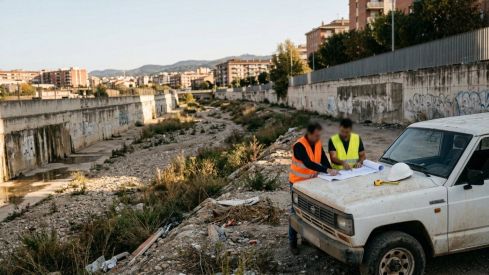
The Terrassa City Council has presented the drafting of a strategic plan to renaturalize and adapt the Palau, les Arenes, and Rubí streams to climate change. The mayor, Jordi Ballart, announced it together with the Deputy Mayor for Ecological Transition, Noel Duque, the architect from AldayJover Jesús Arcos, and members of the Rieres Commission.
The proposal starts from a paradox that conditions the entire project. The city council wants to integrate the streams into the city and turn their banks into more habitable spaces, but the riverbed will not be able to accommodate parks or activities due to the intensity of the flow, so the transformation will have to be done outside the space occupied by the water.
Ballart framed the initiative as a long-term action and argued that the streams should no longer be seen as a physical barrier or as simple drainage channels. The plan, however, will not begin to be drafted until the next municipal term, starting in 2028, and will require the participation of several administrations.
The calendar sets a first draft in December and the definitive plan in 2027
The study will start with a first participatory session in September. Afterwards, the drafting team plans to deliver a first draft in December.
Already in the spring of 2027, the City Council will gather the impressions of the Catalan Water Agency and other stakeholders involved. The delivery of the definitive document is scheduled for December 2027 and the approximate cost of the commission amounts to 361,000 euros.
While that work is being prepared, the council maintains actions on the ground. This year it has already repaired some walls and removed vegetation from the les Arenes stream, where more interventions are planned in the coming months.
"While we think about the city of the future, we must continue improving the city of the present" - Jordi Ballart, mayor of Terrassa
Jesús Arcos rules out parks in the riverbed and plans to act on the banks
The architect Jesús Arcos advanced that Terrassa will not be able to reproduce the model of the Parc Fluvial del Besòs. There, the transformation affected the last nine kilometers of the river in a green space of 115 hectares that crosses Barcelona, Santa Coloma, Sant Adrià and Montcada.
In the streams of Terrassa, the hydraulic situation is different. Arcos specified that the flow is much more intense and that for that reason, occupying the riverbed with citizen uses is not appropriate.
"We cannot occupy the space of the stream's channel to do anything there, as this space belongs to the water" - Jesús Arcos, architect, AldayJover
The intervention, therefore, will focus on the margins and nearby areas. Among the options on the table is the construction of a longitudinal corridor or promenade that connects different neighborhoods crossed by the Palau, les Arenes, and Rubí streams.
Ballart maintained during the presentation that the objective is to thoroughly study the hydraulic, environmental, and social possibilities of these spaces. The mayor set the delivery of the definitive plan for December 2027, with an approximate budget of 361,000 euros.