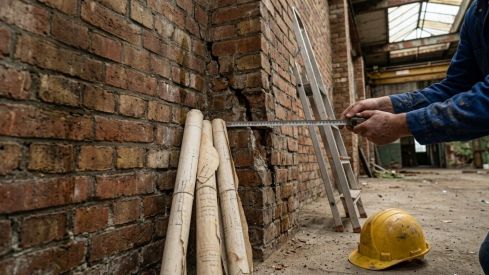
The plenary of Tarragona has approved modifying the heritage protection level of the old Tabacalera to adapt the premises to safety regulations and unblock its use after almost two decades closed. The measure was approved with the votes of PSC, ERC, Junts and non-attached councilors, the abstention of En Comú Podem and Vox, and the rejection of the PP.
The tension of the debate was fixed on a specific point. The complex, of 70,000 square meters and destined to house new facilities, maintains a protection that prevents the installation of basic elements such as emergency exits, stairs, or windows, so that preserving the current level is equivalent, in practice, to keeping it without activity.
The reclassification allows adapting 70,000 square meters to regulations
The modification converts the monument into a Bé Cultural d'Interès Local (Asset of Local Cultural Interest), a figure with which the City Council intends to introduce specific changes without eliminating heritage protection. The objective is to make the adaptation of the premises possible and open it to citizen use.
Nacho García, councilor for Territory, argued that the government seeks to "open the premises, after 20 years closed" and reconcile heritage and daily activity. In his speech, he maintained that technicians demand "surgical changes" so that the space can function.
"The objective is to open the premises, after 20 years closed. The location is privileged, it will generate a new centrality looking towards Ponent, next to the Francolí, to reconnect the city through culture and education, but now we need to find a balance between heritage and citizen activity. Therefore, technicians are asking us for surgical changes" - Nacho García, councilor for Territory, Tarragona City Council
The Pla Tabacalera foresees an investment of 45 million euros contributed by three administrations, the City Council, the Generalitat de Catalunya, and the State. Junts linked this flexibilization to specific projects such as Euses, the conservatory, or the library.
Jordi Sendra, spokesperson for Junts, called for a "more dynamic" approach to facilitate these facilities. Xavier Puig, from ERC, argued on his part that, if action is not taken now, the premises could remain closed for another fifty years.
The PP warned of the heritage risk and Viñuales rejected the 170 million museum
The main opposition came from the PP. Maria Mercè Martorell, spokesperson for the group, described the decision as a "barbarity" and argued that any change should be processed project by project, not through a general review of the protection level.
Martorell also warned of the proximity of the complex to the Necropolis, declared a World Heritage site. Her group maintains that the reclassification could compromise the value of the monumental complex.
Rubén Viñuales responded that "nothing is declassified, the level is changed" because, with the current arrangement, no action could be carried out. The mayor added that the proposal comes from municipal technicians and dismissed the PP's alternative of promoting a museum valued at 170 million euros as unrealistic.
There were also reservations among the groups that did not vote in favor. Judit Gómez, spokesperson for Vox, asked the municipal executive to seek private investment, while Jordi Collado, from En Comú Podem, questioned whether the government had a defined plan and linked the operation to the intention of facilitating the arrangement of Euses.
In his final reply, Viñuales once again focused the argument on the safety of the building and asked how emergency exits could be installed if the reclassification does not proceed. The debate over the Tabacalera, closed for almost 20 years, thus points to becoming one of the key issues in next year's municipal elections.