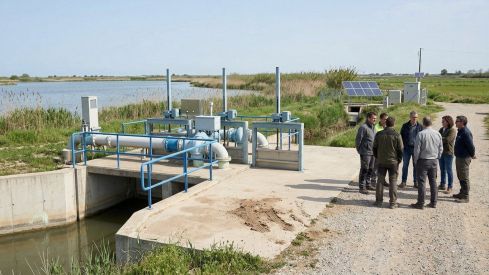
A delegation from the Czech Government has toured the Ebro Delta to inspect the actions of the Generalitat aimed at curbing land subsidence. The entourage traveled to the area to learn firsthand about the technical advancements and hydraulic works being developed by the Department of Territory, Housing, and Ecological Transition.
Advances in Water Management and Coastal Protection
The group is composed of representatives from the Ministry of Environment of the Czech Republic, academics from the University of Life Sciences Prague, and experts from firms dedicated to water infrastructure management. Their presence in Baix Ebre responds to a shared interest in the solutions applied in a wetland area with challenges similar to European ones.
During the tour, technicians have inspected pumping stations in the bassa de l'Encanyissada and the bassa de la Tancada within the framework of the Integral Plan for the Management of fresh water in the Ebro Delta. These facilities seek to increase the contribution of fresh water through new photovoltaic technologies and more efficient collection systems that collect water from discharges to return it to the basses. The Catalan administration aims to achieve the best possible water management to reverse the progressive sinking of the land.
A new continuous sensor system for lagoons and bays is currently out to tender, which will allow for the monitoring of key parameters such as water renewal, salinity, oxygen, and temperature. The procurement of batteries to provide greater stability and operating time for the pumping stations is also planned to begin soon.
The visit included a tour of the works of the protection dikes of the Alfacs bay and the interior lagoons. The interventions in the Alfacs bay have made it possible to raise the level to reach 1.2 meters in height to prevent the entry of saltwater into the fields. So far, most of the 15 kilometers of the dike's route intended to protect this coastal area has been executed.
The work on the interior lagoons is already finished while authorization is awaited to execute phase three of the actions in the bay of Alfacs. In parallel, work is underway on drafting the project for the Fangar breakwater. The Czech delegation showed special interest in learning about the technical proposals designed to help resolve future flooding problems in the territory.
This exchange of experiences is added to the interest shown last year by a delegation from Turkey, which also approached the delta to evaluate protection strategies. The mobility of international experts ratifies the importance of the integrated management model that the Generalitat applies in the Ebro ecosystem against subsidence and marine pressure.