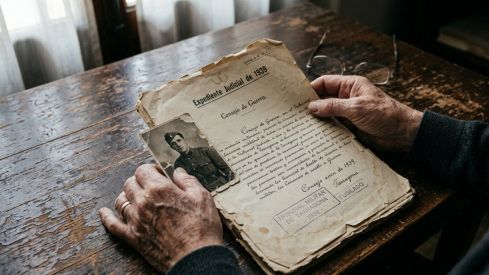
The family of Francesc Lorente, an assault guard born in Tortosa in 1910, has claimed institutional recognition and professional rehabilitation for agents who remained loyal to the Second Republic during the Civil War. The request for institutional homage and restitution of his professional status was submitted in March 2025 and remains unanswered.
The petition comes months after the Directorate General of Democratic Memory recognized Lorente as a victim of Francoist persecution and annulled the court-martial that convicted him in 1939. The family considers, however, that this reparation is incomplete as long as his status as an agent and his rank are not also restored.
The resolution annulled the conviction, but did not restore his police rank
In September of last year, the Directorate General of Democratic Memory issued a resolution on Francesc Lorente's case. The document recognizes the persecution suffered during Francoism and nullifies the court-martial that convicted him for aiding rebellion.
Lorente was arrested in May 1939, tried in Tarragona in August of the same year, and sentenced to twelve years and one day in prison. He served his sentence in Reus prison until 1941 and obtained a pardon in 1946.
For his descendants, the problem does not end with the judicial annulment. Daniel Lorente maintains that a professional reparation is missing to restore his grandfather to the status of agent from which he was stripped after the war.
"Why is the police force undermined in this way, and by extension people like my grandfather, who defended citizens' rights until the last moment?" - Daniel Lorente, grandson of Francesc Lorente
The family's claim connects with the debate on public recognition of civil servants and agents who remained on the side of republican legality. In this context, the judicial proceedings held in Tarragona once again become the center of the discussion on pending reparations.
The family submitted the petition in March 2025 and has not yet received a response
Daniel Lorente has explained that the formal request for institutional homage and professional rehabilitation was registered in March 2025. To date, the family has not received a response to this petition.
The assault guard's grandson has also highlighted the personal scope of this lack of recognition. "This issue hurts us all," he stated, referring to the impact that the post-Civil War repression had on his family.
The conviction and its consequences pushed the Lorente family to rebuild their lives outside of Spain. That family journey is one of the arguments that now support the demand for full restitution, beyond the annulment of the military proceeding issued in Tarragona in August 1939.
Francesc Lorente obtained a pardon in 1946, after having gone through the Reus prison following a sentence of twelve years and one day imposed by a court-martial that has since been annulled.