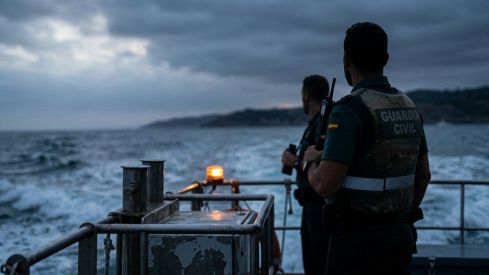
The Civil Guard maintains 19 open operations against organized crime in the province, six of them linked to drug trafficking, at a time when the corps has already detected vessels related to drug trafficking on the coast. The data was presented on Wednesday by Lieutenant Colonel Jordi Verger, head of the Command, during the ceremony for the 182nd anniversary of the armed institute.
The main warning Verger issued was the gap between the volume of police activity and the level of resources it claims to tackle it. While the command investigates increasingly violent networks with a greater presence of firearms, its head called for regulatory changes, better judicial procedures, and more protection for officers.
Verger warns of six cases for drug trafficking and more firearms in actions
During his speech, Verger maintained that organized crime understands no territorial limits and that the province must be prepared for the impact of drug trafficking on the coast. The reference comes after the Guardia Civil has already located vessels linked to these activities on the coast.
"We are seeing that organized crime is increasingly violent. We are seeing more firearms in our actions" - Jordi Verger, head of the Civil Guard Command
The command added that the situation forces a review of the institutional response. In another of his interventions, he demanded new regulation, better judicial procedures, and greater security for agents, in addition to asking for political consensus to provide security forces with more effective tools.
Verger also linked that claim to the risk assumed by frontline personnel. He stated that the country cannot afford "a single more loss of colleagues" at the hands of organizations that profit from drug trafficking.
The command added 40,000 actions and foresees more controls on the coast this summer
The balance of the last year places operational pressure on several fronts. The Civil Guard investigated 400 crimes, arrested 380 people, and also maintains 40 investigations for computer and technological crime, along with actions for radicalization and arms trafficking.
In parallel, the body processed more than 5,000 administrative complaints for environmental, maritime, weapons, or smuggling violations. To this are added nearly 600 aids and rescues, 5,700 inspections and searches, and more than 21,000 identifications.
Together, the command's activity reached nearly 40,000 actions, with an average of 110 interventions daily. Verger highlighted the coordination with Mossos d'Esquadra, Policía Nacional, and local police forces, although he admitted that jurisdictional conflicts persist in the maritime domain.
That mention links to the case of the rescue of the body found in La Pineda in March, cited by the head of the Command himself as an example of those friction points in the division of functions on the coast.
With summer approaching, the Guardia Civil plans to reinforce maritime surveillance with inspections of recreational boats and checks along the coast. It will also intensify the fight against smuggling and crimes against industrial property in tourist areas.
"We are working so that this activity does not increase and to guarantee that people can be in tourist areas with peace of mind" - Jordi Verger, head of the Civil Guard Command
The government's deputy delegate, Elisabet Romero, framed the improvement of resources within budgetary availability. During the event, she pointed out that, with investment, services can always be improved, in a scenario of extended budgets.
Verger also denounced the deterioration of the barracks in Valls, Reus, and La Ràpita due to lack of investment, and specified that the new barracks in Amposta will begin construction shortly and will be operational in approximately one and a half years.