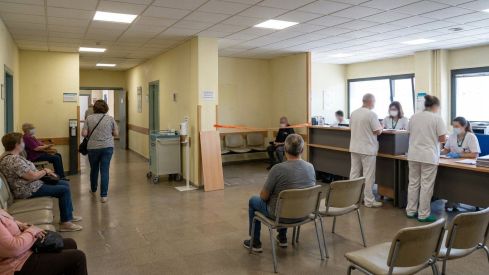
The Jaume I Primary Care Center in Tarragona is initiating a broad interior adaptation process aimed at reducing healthcare pressure and optimizing facilities for professionals and patients. The interventions, promoted by the Institut Català de la Salut, are expected to last several months and, if current schedules are maintained, will be fully completed during the autumn.
Technical intervention and care continuity
The execution of the works corresponds to the company Construccions Capsana, which has an awarded budget of 161,913.58 euros including VAT. The work plan is structured in sequential phases to avoid any interruption in the provision of services. During the construction period, the clinic will maintain its normal operations by applying specific sectorizations and enabling alternative routes. Specific protocols will be implemented to control noise and dust, ensuring the safety and comfort of those who attend the center.
Reorganization of spaces and improvement of care
The project addresses a comprehensive redistribution of the ground floor and common areas, with special emphasis on the main entrance, admissions, waiting rooms, restrooms, and medical consultations. The main actions include
- Reconfiguration of the administrative area under a differentiated scheme of front office and back office service.
- Creation of a closed office for sensitive administrative procedures, thus fulfilling the users' historical request to recover privacy in health-related matters.
- Expansion of the waiting room by recovering previously underutilized spaces.
- Conversion of old changing rooms and unused facilities into two new medical consultations.
- Total renovation of public restrooms incorporating universal accessibility standards.
- Relocation of fixed sanitary equipment, including the non-mydriatic camera necessary for ophthalmological examinations.
This remodeling constitutes a necessary response to the critical capacity situation the center is experiencing. The Jaume I CAP is emerging as the most saturated facility in the city, serving a reference population that far exceeds more than 32,000 users, a figure much higher than the 20,000 recommended by technical parameters. With more than two decades of age, the building requires solutions that current reforms can only address temporarily.
Disputes over the future of equipment
The works are conceived as a palliative measure while the definitive strategy for the center's headquarters is consolidated. No news is registered regarding the expansion and relocation project planned in the Francesc Bastos area. Institutional dialogues remain open without any concrete resolution or signed decision on the final location having appeared. In parallel, the future Tarragona Primary Care Emergency Center remains in the study phase, with the aim of absorbing part of the demand that currently saturates hospital emergencies through uninterrupted 24-hour care. The alternative that places the CUAP next to the possible relocation of CAP Jaume I in Francesc Bastos gathers the highest degree of consensus among the analyzed options.