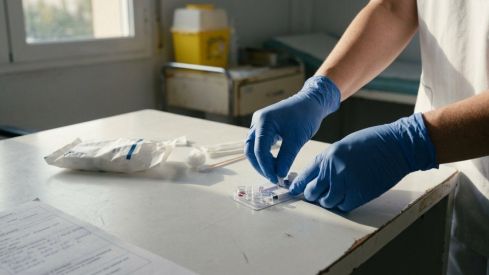
The Roquetes CAP has launched the European COMFORT project to study whether blood microsampling can become a less invasive alternative to conventional venipuncture. The research will also be carried out at the Sant Martí de Provençals CAP in Barcelona and will analyze both the technical feasibility and the acceptance of this system among patients.
The main unknown of the trial is to verify whether an extraction with less invasive burden can work with the same utility in profiles that require frequent monitoring, especially people over 65 years of age and with polypharmacy. The study will test this option in a rural setting like Roquetes and in an urban context like Sant Martí de Provençals.
Roquetes and Sant Martí de Provençals will evaluate 40 patients for one year
In Catalonia, coordination falls to the Clinical Biochemistry, Drug Delivery and Therapy Research Group of the Vall d'Hebron Research Institute and the SINCRONITZA Research Group of the Jordi Gol Primary Care Research Health Institute Foundation. Researchers Noèlia Carrasco, Nerea Bueno, and Àngels Tudó are leading this work.
The trial will follow 40 patients over 65 years of age with polypharmacy. Twenty will go to the health center for nurses to perform the extraction, and another 20 will perform self-extraction from home, with four follow-ups spread throughout the year.
In Terres de l'Ebre, ICS nurses Paula Blasco and Mònica Mulet are participating in the research team. The Roquetes CAP represents the rural area, while the Sant Martí de Provençals CAP provides the contrast of an urban environment.
The study will compare two devices with conventional extraction
The research will pit routine venipuncture against two microsampling systems. One is the Tasso+ arm device, and the other is the Capitainer B50, based on dried blood obtained from the finger.
Noèlia Carrasco, a researcher at IDIAP Jordi Gol in Terres de l'Ebre, frames the focus of the work on daily practice with patients from outside large urban centers.
"Assessing the experience of different extraction methodologies, the efficiency of sample logistics and transport, and patient acceptability" - Noèlia Carrasco, researcher at IDIAP Jordi Gol in Terres de l'Ebre
COMFORT is developed simultaneously in Spain, France, Sweden, the United Kingdom, and the Czech Republic, within a network that can reach up to 14 European countries. The project also includes the elderly, cancer patients, people with cardiovascular diseases, and the pediatric population.
The total funding amounts to 8 million euros for a four-year project. Of that amount, 300,000 euros correspond to Terres de l'Ebre.