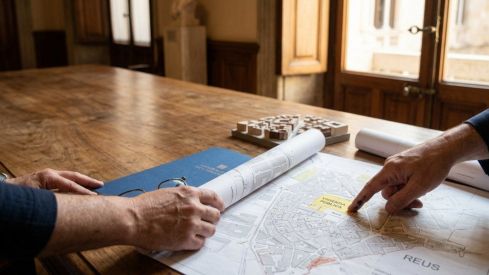
The mayor of Reus, Sandra Guaita, and the president of the Generalitat de Catalunya, Salvador Illa, addressed this Tuesday at the Palau de la Generalitat a battery of investments and projects for the city, with housing, mobility, and facilities as the main axes of the institutional meeting.
The meeting left a paradox on the table that the municipal government has been repeating in recent months. Reus wants to accelerate its growth in areas such as Mas Iglesias and at the same time suffers from old deficiencies in southern neighborhoods, where the City Council identifies a pending debt while demanding new public developments, better connections, and more facilities.
Reus plans 192 apartments and has already activated another 129 on ceded plots
Guaita reiterated the municipal will to advance in the affordable public housing developments that are already under construction in Mas Iglesias and La Riera, with a total of 192 new apartments underway. From the Palau de la Generalitat, the mayor framed that impulse within the Pla 50.000, which she defined as "an excellent opportunity" to continue expanding the offer.
In addition, the City Council made available to the Generalitat two plots located at Ball de Diables, 1, and Vilafortuny, 36. Both were accepted in the first call for public reservation of plots for protected housing and will allow for the construction of 129 more homes.
The meeting also served to review other urban projects linked to the city's growth. Among them is the promotion of protected housing and the need to accompany this residential increase with new services and connections in the expanding neighborhoods.
Guaita places Reus Sud and Astorga street at the start of the transformation
During the meeting, the mayor presented the evolution of the Pla de Barris Reus Sud and detailed the transformation works on Astorga street. The project aims to turn this street into a civic axis with more green areas, resting spaces, more security, and better lighting.
Guaita defended this action as the beginning of the transformation of these neighborhoods and recalled that the city has a historical debt with them. The action in Reus Sud was thus linked to a broader agenda of urban rebalancing between the areas that are growing faster and those that have accumulated deficits for years.
The Generalitat is studying the new bus station next to Reus-Bellissens
Another of the meeting's blocks focused on the infrastructures called to redefine mobility towards Camp de Tarragona. In that folder appear the intermodal station of Vila-seca, the second phase of the tram, and the connection of the airport with high-speed rail and with the three airports of Catalonia.
In Reus, the future bus station promoted by the Generalitat is projected as a larger and more modern facility. Its planned location, next to the tram entrance and the new Reus-Bellissens train station, seeks to concentrate several transport nodes in the same place, as other mobility plans for Camp de Tarragona already indicate.
The meeting also included the transfer of the Faculty of Medicine to the Bellissens campus, the evolution of the Tecnoparc towards a technology district, and the future InnoReus project. In the educational and sports field, the mayor advocated for the construction of the Molinet pavilion, adjacent to the IES Roseta Mauri, considering that it responds to both the center and the Mas Iglesias area.
Before closing the day, Sandra Guaita accompanied the Associació d'Amics de Gaudí in their meeting with Salvador Illa, in which the entity presented the program of activities planned in Reus for the Gaudí Year.