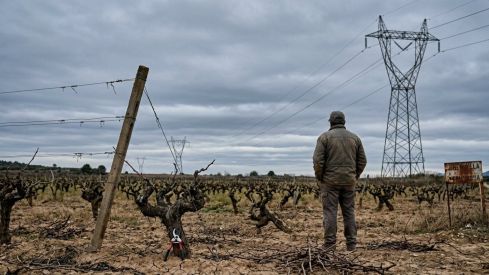
The future very high voltage line between Aragon and Tarragona has received 14,421 objections in the Catalan section and exceeds 17,000 if those presented in Teruel are added. The project foresees a 180-kilometer route between Escatrón and La Secuita and affects 28 municipalities in Terra Alta, Ribera d'Ebre, Priorat, Baix Camp, and Tarragonès.
Local opposition coincides with a process already underway to dismantle the current infrastructure and build another with triple the power and taller towers. This is where the conflict in the territory is concentrated, because Red Eléctrica maintains that it will reach an agreement on the route, while the majority of affected town councils have already formalized objections against the line.
The majority of affected municipalities have already filed objections to the project
Joan Aubanell, president of the Consell Comarcal de la Terra Alta, assures that all town councils in the region except two have registered documents against the MAT. The councils see landscape, environmental, and economic impacts in a corridor that crosses five regions of Tarragona.
Red Eléctrica maintains the permit process to remove the current line and build a new connection with much greater capacity. The company also defends that it will open a dialogue process with the territory to agree on the route.
In parallel, the volume of administrative and neighborhood response has escalated to 14,421 objections on the Catalan side alone. If those collected in Teruel are added, the opposition to the project now exceeds 17,000 objections.
Unió de Pagesos asks to bury the MAT and avoid new expropriations
The agricultural organization demands that the line run underground and utilize public roads. Its proposal is to avoid new expropriations and reduce the impact on agricultural land and natural spaces.
Salomó Torres, representative of Pagesia Gran d'Unió de Pagesos, rejects the formula with which some companies offer rentals for the affected farms. The agricultural leader defines it as emotional blackmail because many farmers consider that land their retirement plan.
In addition to the opposition to the route, Unió de Pagesos wants to bring the debate to the Parliament. The entity announces a motion for all parties to publicly state their position on the MAT.
The platform from La Selva claims the precedent of Albera
Lluís Ginestà, spokesperson for the "No a la MAT de la Selva" platform, frames the rejection within a critique of the energy model linked to large transport infrastructures.
"We do not want a model of large power plants and large distribution networks, which is what the MAT represents, which is the big business of large companies and the great dependence of consumers and countries" - Lluís Ginestà, spokesperson for the "No a la MAT de la Selva" platform
The platform recalls a precedent in Girona to argue that the route can be modified. In l'Alt Empordà, they achieved the burial of a section of the line to save the Albera massif after a consultation and a process of social education.
Faced with the new connection between Escatrón and La Secuita, the agrarian entity proposes alternatives based on local energy communities and a gradual, decentralized energy transition with less dependence on large companies in the sector.