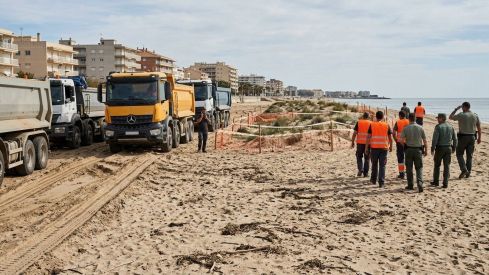
The Rural Agents have forced this Monday to stop the transfer of sand between the surroundings of the port of Coma ruga and the beaches of L'Estany de Mas Mel, in Calafell, an action that had been carried out for days along the shore of the beach to reinforce a section affected by the erosion of winter storms.
The halt comes after Kentish plover chicks, a protected bird, have been born in a nest located near the passage of the trucks. The concern is that the chicks may be crushed by the vehicles during the works.
Stoppage due to the presence of chicks of a protected bird
The sand movement was being carried out at the request of the Calafell City Council. The intervention aimed to complete a contribution of 15,000 m3 of sand on the beaches of L"Estany de Mas Mel, one of the points of the municipality's coastline most affected by the storms of recent months.
Ecologists from Grup Ecologista del Vendrell had already previously denounced the passage of trucks through the nesting area. Despite this, both the Ministry of Ecological Transition and specialists in beach management had initially ruled out an impact on the bird and the nests.
For now, the works have been suspended and it is not clear if they can be resumed. The interruption comes when there were few days left to finish the planned work and complicates the schedule of a project that the Ministry finances this year.
Calafell fears not completing the planned contribution
From the Calafell City Council, it is considered that the decision may prevent finishing the programmed sand transfer. The Councilor for Urban Ecology, Aron Marcos, has warned that only four days of work remained and that now they do not know what may happen with the pending section.
"Calafell has that sand deficit. The contribution of sand allows protecting infrastructures. From now on we don't know what could happen" - Aron Marcos, councillor of Urban Ecology of Calafell
Marcos also questions that the passage of heavy machinery on the beach is stopped while work continues in the Coma ruga river area. Furthermore, he maintains that during the days in which the transport was carried out, no impact on the nests had been detected, and recalls that the Ministry had already foreseen personnel to control that the birds did not suffer damage.
A conflict that already confronted Calafell and El Vendrell
The work already generated tensions last year between Calafell and El Vendrell due to the chosen route to move the sand. Then, El Vendrell demanded that the transfer be done through the urban fabric to avoid disturbances both to the nesting of the Kentish plover as well as to the bathers.
Calafell denounced then that preventing passage along the shore delayed and made the action more expensive. That dispute ended up having practical consequences because not all the planned sand could be dumped.
This year, with the performance again underway along the beach, a change of route towards the streets seems difficult due to the deadlines. The suspension occurs when the work was very advanced and without clear margin to reorganize the logistics in so few days.
The specialists had not detected nest abandonment
Among the technicians consulted about the action is the specialist in coastal dynamics Francesc Roig, who had pointed out that the passage of trucks had not caused the abandonment of the nests and that, even, more had appeared. According to his assessment, the birds look for food among the ruts left by the vehicles on the sand.
With the halt ordered by the Agents Rurals, the continuity of the sand supply now remains in the air at a sensitive moment for the coast of Calafell, which sought to reinforce its beaches before the summer and protect a coastal front especially exposed after the winter storms.