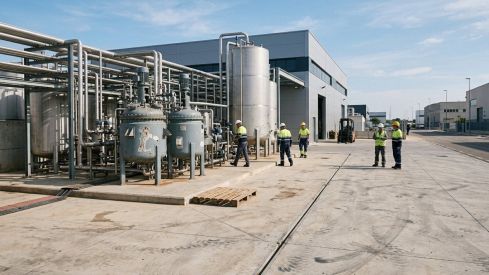
The province of Tarragona will provide coverage for two new chemical recycling plants that will mobilize a total investment of approximately eighty million euros. The larger infrastructure will be located in the Riu Clar Industrial Park in the Tarragona capital, while a second industrial complex will be located in Flix, belonging to Ribera d'Ebre. Both centers aim to transform non-recoverable plastic waste through conventional methods into secondary raw materials with high added value.
Immediate start-up in the Riu Clar Industrial Estate
Greenertis will start the works with a budgetary allocation of thirty million euros that will allow the activation of twenty-one jobs in the first weeks of operation. The structural assembly will last throughout the year 2027 and the facility will reach its full production pace during 2028. The developer has accumulated a decade of technical research since its first trials in 2017 and plans to double the workforce in the next expansion phase, which will require an additional investment of forty-one million euros complemented by a grant of six million five hundred thousand euros from the PERTE Circular Economy program.
"We are in a first phase, of technological application, of a completely novel plant. We will begin to work, we will make the necessary optimizations to be able to scale to more phases" - Jordi Vaquer, technical director of Greenertis
The industrial process will absorb eight thousand tons annually of waste from the gray bin and will convert them into six thousand tons of pyrolytic oil. This derivative replaces virgin oil in the manufacture of new containers and generates savings equivalent to five thousand tons of carbon dioxide per year. With the definitive deployment, all these figures will experience an increase multiplied by six. The location responds to the consolidated petrochemical vocation of the environment and proximity to large transforming industries.
Technological Expansion and Demand for Institutional Coordination
The same operational scheme will be transferred to Flix through the 2G Chemical Plastic Recycling project, which contemplates a budget of thirteen million seven hundred thousand euros and state aid of two million one hundred thousand euros. The execution of this public financing is subject to a maximum deadline that ends in November 2027. The company firmly maintains that it will proceed with the construction of the complex regardless of the final resolution of municipal and regional subsidies.
"We will recover 85% of the polyolefin through slow pyrolysis, which is the opposite of combustion" - Daniel Vega, CEO of 2G Chemical Plastic Recycling
"There is a part of the plastic that cannot go to mechanical recycling because it is dirty and mixed. We intervene there and accept very low-quality plastics, difficult to recycle" - Cristina Leahu, development director of 2G Chemical Plastic Recycling
The new factory will include between five and six industrial reactors and will create between thirty and forty specialized positions. Since 2021, a pilot unit has been operating in Ascó, employing around twenty people. The promoters acknowledge that the project must initially overcome the granting of environmental and urban planning licenses to begin operations. The promoting entities have explicitly requested smoother management between the different administrative levels to synchronize permit procedures with public economic incentives and guarantee the temporal viability of investments.
The arrival of these industrial complexes consolidates the demarcation as a strategic node for the circular economy in Catalonia. Local authorities and the business community will closely monitor compliance with the established deadlines and the effective integration of these advanced technologies into the regional productive map.