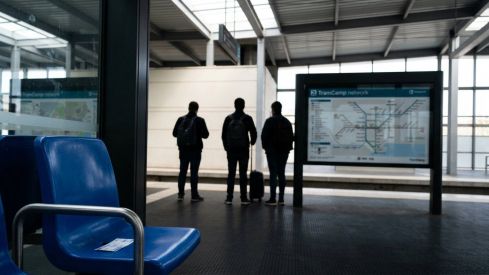
ERC has linked its support for the budgets to the deployment of a 24-hour stroke service in Camp de Tarragona and the definitive advancement of the TramCamp, two commitments that place the negotiation in the realm of concrete results.
The tension of the negotiation lies in the fact that institutional stability is made subordinate to two very specific territorial demands. Support does not depend on a declaration of intent, but on these promises being translated into verifiable measures in health and mobility.
ERC conditions the budgets on 24-hour stroke care in Tarragona
The announced budget agreement incorporates the implementation of a 24-hour stroke service as a central demand. The planned coverage extends to both Camp de Tarragona and Terres de l'Ebre.
With this approach, ERC sets a negotiation line based on measurable commitments. The party has established that the conversion of promises into verifiable results will be the requirement that marks its strategy in the budget negotiation.
TramCamp will connect five municipalities with university and industrial hubs
Alongside the health front, the pact includes the definitive boost to the TramCamp project. The infrastructure is planned as an integrated mobility network to connect Tarragona, Reus, Vila-seca, Salou, and Cambrils.
This network must also link the main university, industrial, and tourist hubs of the territory, with a scheme that goes beyond the connection between municipalities and seeks to articulate daily travel in one of the most active areas in southern Catalonia.
The combination of both conditions places the negotiation in two areas of direct impact for the territory. On the one hand, 24-hour stroke care for Camp de Tarragona and Terres de l'Ebre. On the other, an infrastructure intended to link Tarragona, Reus, Vila-seca, Salou, and Cambrils within the same integrated mobility network.
ERC has set as a condition of its negotiation strategy that these promises be converted into verifiable results.