El Govern will approve this Tuesday in the Consell Executiu the Pla Cura, a new model to manage dependency that sets as objective to cut deadlines in Tarragona and in the whole of Catalunya. The goal is clear. To go from the current 397 days of waiting to a maximum of 60 days in the entire process, from the application to the resolution.
The starting situation in Tarragona Nord, through SEVAD, reflects the bottleneck that is intended to be corrected. In May of last year there were 3,950 pending assessments and the waiting time to obtain a benefit stood at 306 days, close to ten months. That period was divided into 188 days to assess the degree of dependency and another 85 to elaborate the Individual Attention Program, known as PIA.
In cases where a residential place was recognized, the delay was still greater. To that administrative process, one had to add the wait to access a place, which exceeded a year.
Provisional benefit for those who are still waiting
The plan foresees an automatic and provisional minimum coverage benefit for people who are waiting for an assistance resource and cannot yet access it. The aid will be between 100 and 200 euros monthly depending on the recognized degree.
- 100 euros for grade I
- 150 euros for grade II
- 200 euros for grade III
The measure will reach about 6,700 people. It will be applied to new applications submitted from now on and will be paid retroactively within a few months, when the Generalitat has completed the deployment of the plan. It will also be collected by people who are already waiting and have a recognized grade III.
A single visit and faster resolution
One of the central changes will be the unification of procedures. The assessment of the degree of dependency and the Individual Care Program will be carried out in a single home visit and will result in a single administrative resolution. The system also incorporates an express PIA in 15 days to accelerate the granting of benefits.
This fast circuit will apply to those who opt for economic aid for caregivers in the family environment, a path that represents 81% of new applications. In these cases, the forecast is that the benefit can be obtained at the same moment of the assessment and start being collected in 15 days. The estimated impact is about 65,000 people per year.
Digitization and semiautomatic recognition of grade III
The deployment of Pla Cura will include the technological tool vSocial, with artificial intelligence, to digitize and automate the process. Starting in June, degree III will be granted to 18,200 people semi-automatically.
The data integration between the healthcare system and social services will allow to avoid new in-person visits and redundant verifications in part of the files. In those cases, a call or video call based on the already existing medical reports will be sufficient.
The new model also foresees fast and specialized circuits to attend in a priority manner to people with severe mental health problems and children under 6 years of age.
Processing from the CAP and more staff
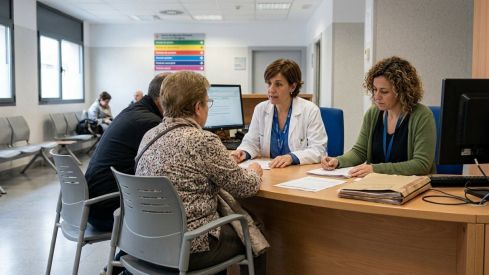
When the plan is fully deployed, dependency procedures can be initiated at the Primary Care Center to offer comprehensive and closer care. The change is supported by a relevant operational data point. 99.7% of applicants are already identified in the healthcare system, which will allow management to be initiated directly from their CAP.
The reorganization will replace the 25 isolated assessment teams with a network formed by 375 primary care teams and 107 basic social services. Doctors and social workers will address each case jointly and will assign each person a reference professional to accompany them throughout the entire process.
The deployment will be progressive. A first phase, between September 2026 and March 2027, will reach one million inhabitants. The extension to the whole of Catalunya will be completed between March and December 2027. The structural change will be accompanied by an additional investment of 25 million euros and the incorporation of 200 new professionals.