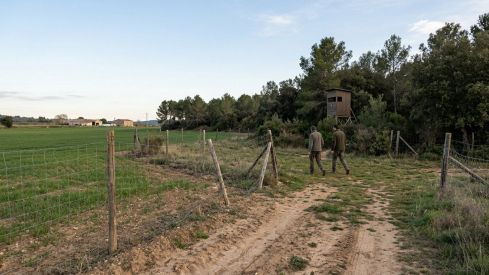
The Generalitat will advance the start of the wild boar hunting season in Catalonia to June and will eliminate the ordinary closed season that until now ran from April 1 to June 30. The measure was announced this Thursday at the Consell de Caça de Catalunya with the aim of reducing the population of the species and reinforcing the prevention of African swine fever.
The new calendar will also allow action during April and May. In those two months, wild boar hunting will be authorized by stalking during daylight hours and also by waiting in the late afternoon or during the night.
End of the spring break
The change eliminates the months in which hunting could not be done ordinarily, a window that until now extended between April 1 and June 30. With this modification, the Department of Agriculture, Livestock, Fisheries and Food aims to maintain more continuous hunting pressure on a species whose presence has skyrocketed in recent years.
The waiting technique consists of remaining hidden for hours and making a selective shot when the animal appears. The administration considers that this system generates less disturbance to the rest of the fauna and offers greater safety conditions.
Objective of reducing density
The Government sets as a reference returning to levels similar to those of 2010, with a density of between 2.5 and 4 animals per square kilometer. The advancement of the calendar is proposed to minimize crop damage, reduce traffic accidents caused by wild boars, and reinforce the prevention of ASF.
The Generalitat insists that hunting will not be the only tool. The strategy also involves limiting the availability of food in the environment, improving waste management, and reinforcing crop protection, with the idea of containing the species' reproduction and reducing its expansion.
The prevention of African swine fever is one of the central arguments of the decision. The Catalan Executive maintains that the combination of hunting and environmental management measures must serve to reduce the pressure of wild boar on the territory and contain the risks associated with its high density.