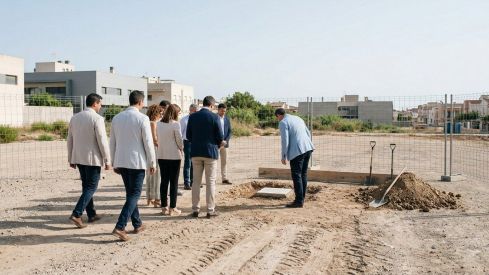
This Wednesday, the first stone of the new Barnahus center, which the Generalitat will promote in the Sant Llàtzer neighborhood, on land belonging to the Consell Comarcal del Baix Ebre, was laid in Tortosa. The future facility will replace the current service, operational in Quatre Camins, and will strengthen care for children and adolescents who are victims of sexual violence in the Terres de l'Ebre.
The planned investment amounts to 1.5 million euros with funding from Next Generation funds. The event was attended by the Secretary General of the Department of Social Rights and Inclusion, Raúl Moreno Montaña, along with the president of the Baix Ebre Regional Council, Antoni Gilabert Rodríguez, the mayor of Tortosa, Mar Lleixà Fortuño, and the Secretary of Life Cycles and Citizenship, Teresa Llorens Carbonell.
A new building in Sant Llàtzer
The new Barnahus will be built with a concept designed to reduce the impact on the children served. The building will have a lot of wood and a house shape to offer a welcoming appearance. The chosen location is in Sant Llàtzer, on land ceded by the Consell Comarcal del Baix Ebre.
"Child protection is a goal for the Generalitat de Catalunya" - Raúl Moreno Montaña, Department of Social Rights and Inclusion
The mayor of Tortosa has expressly thanked the Baix Ebre Regional Council for the transfer of the land. During the event, Mar Lleixà defended that the project represents an advance in the protection of children and adolescents in a safe environment.
"Today we take a very important step in the protection of children and adolescents, putting them at the center and in a safe environment" - Mar Lleixà Fortuño, mayor of Tortosa
Comprehensive care in the same space
Barnahus is a service of the Govern de la Generalitat promoted by the Direcció General de Prevenció i Protecció a la Infància of the Departament de Drets Socials i Inclusió. The model is based on comprehensive care for victims with coordination between different departments in a single space, away from police stations and hospitals.
Since its launch in 2024 in Tortosa, the service has assisted 200 children. Raúl Moreno has pointed out that this figure may only be part of the detected reality. He has also stressed that this system allows for the reduction of child re-victimization, as the victim only has to explain their experience once.
"It is probably the tip of the iceberg" - Raúl Moreno Montaña, Department of Social Rights and Inclusion
One of the central pieces of the model is the closed-circuit television to record the testimony of the child or adolescent and generate a pre-constituted piece of evidence. This avoids the victim having to testify an average of four times in different places and before different people.
How the current Quatre Camins center works
While the new building is being developed, the service continues to operate in the current Barnahus in Tortosa, located in the Quatre Camins neighborhood. This facility has two separate waiting rooms with furniture, toys, magazines, and books, in addition to a workspace for professionals.
- Two multipurpose rooms for interviews and for attending to families, children, and adolescents
- A forensic examination room for pre-constituted evidence
- An observation room for viewing examination interviews
- A medical examination room with a bathroom
- A kitchen and other support facilities
The Generalitat's forecast now involves transferring this model to a new building in Sant Llàtzer, with a more child-friendly design and with the same objective of concentrating professional intervention in one place to avoid further exposure of victims during the care process.