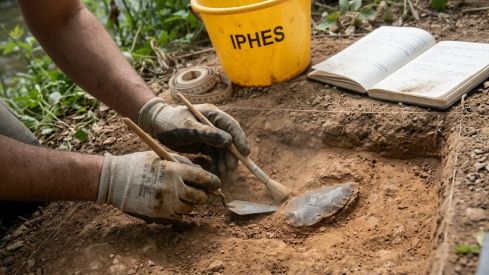
A team from IPHES-CERCA has been excavating the Cansaladeta site in La Riba since May 4th, to expand the area opened in the previous campaign and deepen the study of level L of a site approximately 400,000 years old. The work will continue until May 20th at this Paleolithic hunter-gatherer settlement located next to the Francolí River.
The intervention arrives at a singular point for the investigation in Camp de Tarragona. La Cansaladeta is among the oldest evidence of human presence in the area, but the territory offers indications of occupation for almost a million years due to the proximity of the Acheulean complex of Barranc de la Boella.
The excavation expands the open area and focuses on level L
Archaeologists Andreu Ollé and Josep Maria Vergès are directing a campaign that seeks to continue the work initiated in the previous phase. The team wants to gain excavation area and advance in the stratigraphic analysis of one of the levels of the site.
In previous campaigns, researchers recovered stone tools and also sets of fragments that fit together. This material allows the reconstruction of the tool-making sequences and the technical knapping gestures developed by the human groups that occupied the enclave.
La Cansaladeta is located on the left bank of the Francolí, within the gorge of Les Roixel·les, in the municipality of La Riba. Its location places it at a key point for following the prehistoric occupation of the Tarragona regions.
The campaign coincides with a thesis on the bipolar technique on May 22
In addition to the fieldwork, the 2026 campaign coincides with another academic milestone linked to the same site. On May 22, Görkem Cenk Yeşilova will defend a doctoral thesis at the Universitat Rovira i Virgili focused on the analysis of the bipolar technique for the manufacture of lithic tools.
Researchers from IPHES-CERCA and students from the Erasmus Mundus Master's Degree in Quaternary Archaeology and Human Evolution are participating in the excavation. Students from the degree in Art History and Archaeology have also joined.
The project is integrated into the research program on paleoenvironmental evolution and prehistoric settlement in the regions of Tarragona. The initiative also has the collaboration of the La Riba City Council.
The defense of Görkem Cenk Yeşilova's thesis is scheduled for May 22 at the Universitat Rovira i Virgili and will address the bipolar technique applied to the manufacture of lithic tools.