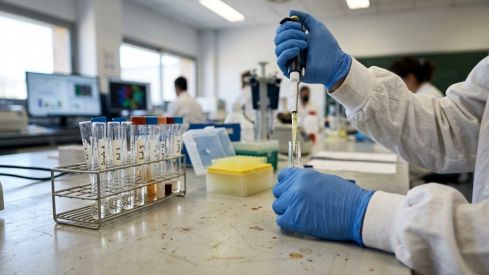
Two research groups from the Universitat Rovira i Virgili are working in Tarragona on the Next-Pandemics project, an initiative funded with 56,250 euros by the Ministry of Science and Innovation to search for antiviral drugs against current and future pandemics. The team combines chemoinformatics, biochemistry, biotechnology, and artificial intelligence to locate useful compounds against Covid, Zika, and dengue.
The project starts from a paradox that researchers consider already assumed. While the accumulated experience after Covid allows for accelerating the search for treatments, climate change, population concentration in urban areas, and globalization favor the appearance and spread of infectious diseases more rapidly.
Santi Garcia-Vallvé, professor of Biochemistry and Molecular Biology at the URV and principal investigator, places the meaning of the work there.
"We have had many pandemics and there will be more, and it is important to continue researching" - Santi Garcia-Vallvé, professor of Biochemistry and Molecular Biology, Universitat Rovira i Virgili
Artificial intelligence reduces billions of compounds to a thousand
The research began in 2020 with the search for compounds capable of inhibiting the main protease of SARS-CoV-2. In that first phase, the team identified the molecules carprofen, celecoxib, sarafloxacin, and perampanel, although their activity proved insufficient.
Now researchers have incorporated new tools to refine that selection. Francesc Serratosa, professor in the Department of Computer Engineering and Mathematics, summarizes the technical leap by pointing out that artificial intelligence allows "to give it another turn now and refine it better."
The model developed by the URV allows pre-selecting drugs from billions of chemical components and reducing that screening to a thousand candidates to validate them later in the laboratory. Gerard Pujadas, a researcher on the project, explains that AI can recreate the chemical component and predict its ability to bind to the target protein.
The team is looking for a common protein in Covid, dengue, and Zika
The next phase broadens the focus beyond the coronavirus. The project works with the idea of simulating what would happen in a dengue or Zika pandemic to locate potent drugs against a specific protease present in both viruses and decisive in the development of both diseases.
Pujadas maintains that in all three cases, including SARS-CoV-2, there is a key protein and that blocking its activity is essential. This coincidence allows researchers to explore a common pathway to respond more quickly to different threats.
In addition to the search for compounds, Next-Pandemics develops open-source tools so that drug discovery can be done in a decentralized manner and accessible from any laboratory in the world.
Around ten people, including doctors, professors, and doctoral students, participate in the project. The work's advances have already resulted in more than twenty scientific articles.
Garcia-Vallvé links this line of research with the previous experience accumulated with other coronaviruses. He recalls that the rapid response to SARS-CoV-2 was partly possible due to the previous work with SARS-CoV-1, which served as a starting point for the drug developed by Pfizer.
Pujadas specifies the team's ultimate goal by stating that the research seeks to react sooner to a situation similar to that of Covid and prevent loss of life.