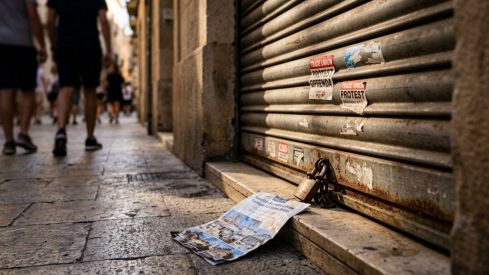
Parc Central has filed a claim before the Administrative Litigation Court to force the Tarragona City Council to initiate the expansion of the Tourist High-Traffic Zone and be able to open on Sundays. The shopping center bases its request on its proximity to the Paleo-Christian Necropolis, integrated into the Roman archaeological complex of Tàrraco, declared a World Heritage Site by UNESCO in 2000.
The claim comes after the municipal government has publicly rejected this change and has supported a motion by ERC against the liberalization of hours. The paradox is that Parc Central invokes a heritage site, which has largely remained closed to the public since 1992, as a tourist argument.
The PSC supported the rejection of opening large stores on Sundays
The PSC's governing team supported a motion by ERC in the plenary session against the opening of large stores on Sundays and holidays, with the argument of prioritizing small and medium-sized businesses. The council also rules out requesting the declaration of a Tourist Municipality for the city.
Rubén Viñuales, mayor of Tarragona, and Montse Adan, councilor for Commerce and Tourism, maintain that the local executive does not support the expansion of the Tourist High-Traffic Zone or that designation because it would mean opening every Sunday throughout the city and because there is not enough social consensus.
Adan added that the model defended by the local government does not involve favoring only one part of the sector. The councilor stated that Tarragona needs balanced, vibrant, and sustainable commerce that benefits the entire commercial activity and not through Sunday openings.
The municipal legal services are already preparing the response to the lawsuit. The local government considers that the arguments presented by Parc Central are "very weak."
The law already allows stores under 300 square meters to open
Current regulations already authorize the opening of stores under 300 square meters on all Sundays. Establishments with larger surface areas, on the other hand, can only do so on holidays authorized by the Generalitat de Catalunya.
This framework has placed employers' associations, unions, and urban commerce on opposite sides. Jorge Porte, a representative of UGT, welcomed the municipal rejection and stated that Sunday openings would not serve to create employment, but rather to increase the exploitation of workers in the sector.
Eva Rosal, from CCOO, argued that curbing hourly freedom prevents staff from having to take on more Sundays and holidays, with an added cost to work-life balance. In the business bloc, Xavier Rigau, president of Foment Empresarial del Camp de Tarragona, called the municipal vote a "serious mistake" and demanded that each company be able to manage its activity without political interference.
Javier Escribano, from the Associació d'Empresaris de l'Hostaleria, also maintained that for the hospitality industry, a Sunday offers more commercial potential than a Monday if customers spend the day out. Conversely, Raquel Pizarro, from La Via T, valued the council's refusal as positive and argued that prioritizing local commerce and small businesses is essential for the activity on the streets of the center.
The Necropolis has remained closed since 1992 despite an investment of nine million
The heritage argument of Parc Central clashes with the situation of the Paleo-Christian Necropolis. Most of the site has remained closed to the public since 1992, although its rehabilitation has mobilized an investment of nine million euros.
Furthermore, as of today, this action has no reopening date. Despite this, the Cambra de Comerç has used the city's tourism forecasts to request the declaration of a Tourist Municipality, an option that the City Council has also dismissed.
Another figure weighs in on this debate. The forecast points to the arrival of 23,000 cruise passengers in 2026, the data that the Cambra de Comerç used to request the designation of Tarragona as a Tourist Municipality.