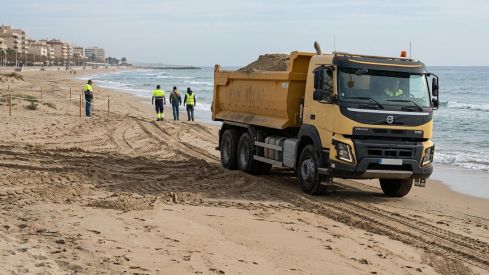
The trucks continue circulating these days along the shore between the area of Coma-ruga port and the beaches of Calafell as part of the sand transfer operation to repair the erosion caused by the winter storms. The operation affects sections of El Vendrell and Calafell and will last for several days.
The intervention is carried out by the Coastal Demarcation of the Ministry for Ecological Transition, which assumes the cost of some works planned as an emergency measure. This year it is planned to move about 15,000 cubic meters of sand to especially reinforce the beaches of L"Estany and Mas Mel.
Emergency intervention and transport by the beach
The Ministry maintains that, because it is an extraordinary and emergency action, it does not need permits such as that from the Technical Office for Environmental Assessment and Management of the Generalitat. It also defends that the transfer is carried out with precautions and with personnel located at the most sensitive points where the bird has already nested, with the aim of avoiding an impact on the clutches.
The passage of trucks through the sand reopens a debate that was already experienced last year. Then, the transport had to be done through the streets after El Vendrell rejected the passage through the beach considering that it could affect a protected bird that breeds in the area. Calafell maintains that that obligation to move the sand by road made the operation more expensive and delayed the works, to the point of preventing all the sediment that was considered necessary from being poured into L"Estany and Mas Mel.
The complaints of the environmentalists for the habitat of the Kentish plover
The environmental group Geven, from El Vendrell, has expressed its rejection of the operation. The entity questions that the passage of heavy machinery is allowed again through a space that it considers especially sensitive in the middle of the breeding season of the Kentish plover.
"It is surprising that despite previous meetings and incidents from previous years, a complete lack of sensitivity is shown towards a system as fragile as the habitat of the Kentish plover at a key moment such as the breeding season" - Geven, environmental group of El Vendrell
Environmentalists maintain that the transfer by the beach responds to an economic decision above scientific and environmental criteria. They add that they are aware that the Generalitat did not report favorably on this system and that it advises against transport by sand. They also reject that it can be justified as an emergency, understanding that it is an action planned every year.
Geven warns that, although there are guards to prevent direct damage to the nests, heavy machinery compacts the sand and generates vibrations that can hinder the feeding of the Kentish plover, cause the abandonment of nests or prevent new layings. The entity also cites the regulations for the protection of the species and its breeding and feeding area, and maintains that this protection is not compatible with the passage of trucks.
"In the midst of a climate emergency we cannot continue seeing the beach and the sand as a simple tourist resource" - Geven, environmentalist group of El Vendrell
The environmentalists do not rule out legal actions and warn that they will closely follow the development of the works in this coastal stretch of Baix Penedès.
The endorsement of the Calafell City Council
The mayor of Calafell, Ramon Ferré, endorses the transfer of sand along the beach and reminds that it has authorization from the Ministry. The councilor considers that the passage of trucks has no effect on the bird, a position he already defended last year and which he has reiterated this week with the start of the sand movements.
Ferré interprets that the development of the operation demonstrates that the circulation of trucks does not affect breeding areas. Furthermore, the City Council values that on this occasion it is the Ministry that assumes the cost of a key action to recover width in the beaches most affected by storms.
The operation remains open while the discrepancy persists between administrations and environmentalists about the real impact of transport along the shore at a particularly sensitive time for the fauna that nests in this sector of the coast.