The reservoirs of Lleida store enough water to generate 1,620 GWh of hydroelectric energy, an amount equivalent to more than 60% of the province's annual electricity consumption. Red Eléctrica placed that demand at 2,558 GWh in 2024.
The figure coincides with an irrigation campaign that has gone from restriction to abundance. While the average filling for the last five years was around 50%, the dams in the basin are now around 90% and some have had to release water to manage snowmelt and rainfall.
Reserves exceed 90% and cover more than half of the electricity demand
The Hydrographic Confederation of the Ebro estimates the volume stored in the Segre and Noguera Pallaresa dams at 1,050 cubic hectometers. Of that total, 781 cubic hectometers are turbinable and equivalent to 848 GWh.
In the Noguera Ribagorçana and Ésera basin, the stored water reaches 979.5 cubic hectometers, with 571 turbinable equivalents to 745 GWh. The Garona adds another 3.5 cubic hectometers, with a potential of 27 GWh.
Combined, the three areas reach those 1,620 GWh of potential hydroelectric production. The figure gains significance in a province whose electricity consumption represents around 6% of the total for Catalonia, which reached 44,113 GWh in 2024.
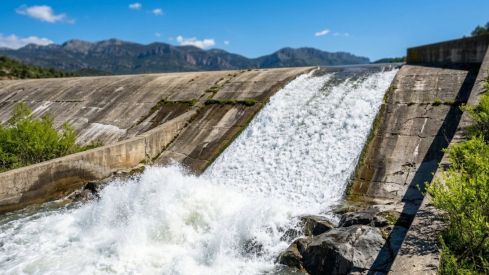
Rialb opened its spillways three times and the Canal d'Urgell has already given a sixth shift
On the Segre River, Oliana and Rialb are close to full. Reserves stand at 95% and 99% of their capacity, respectively, although the most recent data places them at 94.5% in Oliana and 99.1% in Rialb, with volumes exceeding 400 and close to 80 cubic hectometers.
During this spring, Rialb has opened its spillways on three occasions and has carried out releases to prevent floods associated with rainfall and snowmelt. On the Noguera Pallaresa, Tremp is at 99%, Terradets at 96%, and Camarasa at 77%.
Canelles, on the Noguera Ribagorçana, reaches 84% of its capacity and stores 572 cubic hectometers. With this scenario, the Canal d'Urgell has granted a sixth irrigation shift in the current campaign and is considering enabling a seventh in June.
"Currently there is enough water for this campaign and also for next year, and many farmers already have all their reservoirs full to cope with July and August" - Amadeu Ros, president of the irrigation community
The availability of water contrasts with the situation of recent years in Segrià and the entire Canal d'Urgell system, which had chained restrictions due to the drop in reserves. Now, the level of the reservoirs allows for both electricity generation and agricultural supply to be sustained simultaneously.
Amadeu Ros, president of the irrigation community, also places the room for maneuver beyond the current campaign by ensuring that agricultural ponds are already full to face July and August and that the stored water would also be enough for next year's.