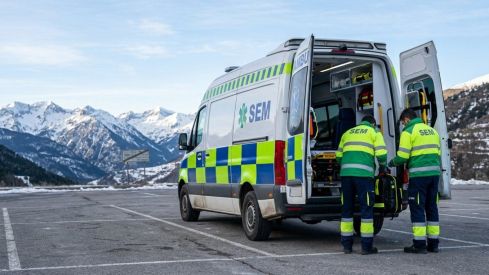
The Emergency Medical System begins this Wednesday the new care and sanitary transport model in the Alt Pirineu with more ambulances, more hours of coverage, and an investment of more than 75.6 million euros for the next five years. The deployment affects a region with large distances between municipalities and points of care, where the reinforcement of resources is concentrated in areas such as Pallars Sobirà, Vall de Boí, Bellver de Cerdanya, and the axis between Alt Urgell and Cerdanya.
The change comes with an underlying paradox. The previous contract had been in effect for ten years, but the new tender increases the investment by just over 2 million while halving the period to five years, and expands the ambulance network from 38 to 45 units, an 18.4% increase.
The Alt Pirineu gains seven ambulances and 9,550 more hours of emergency service
The most visible expansion is in the fleet. The ambulance fleet goes from 38 to 45 units, while the hours of urgent sanitary transport service rise to 133,648 per year, almost 9,550 more than in the previous contract.
In addition to the general increase, the SEM has adjusted coverage at specific points in the territory. Sort will extend its ambulance operating hours from eight to 24 hours a day, and Bellver de Cerdanya will go from 12 to 16 hours.
There will also be a reserve of 3,320 additional hours to activate reinforcements when extraordinary situations occur. Added to this is a support ambulance in Vall de Boí during the winter and summer seasons.
The system incorporates new waiting points in Martinet and Montellà to better redistribute resources. The management of the service in this phase will be in the hands of Transporte Sanitario de Catalunya.
The new contract incorporates multipurpose units, logistical support, and electric vehicles
The tender introduces changes beyond the increase in hours and vehicles. Throughout Catalonia, it plans to renew more than 1,600 urgent and non-urgent sanitary transport vehicles, almost 300 more than in the previous contract, and creates 73 new types of units, of which seven correspond to the Alt Pirineu Health Region.
This deployment includes four multipurpose ambulances for Tremp, La Seu de Urgell, Cerdanya, and Alta Ribagorça. These units will handle low-complexity services and the transport of patients weighing over 170 kilos.
The model also adds a Health Logistics Support unit for incidents with multiple victims, major emergencies, and transfers of emergency psychology professionals. Alongside it, the SEM will deploy two 100% electric shuttle ambulances for short trips between hospitals, with their main base in La Seu d'Urgell and Cerdanya.
The distribution of resources has been defined based on a technical and scientific analysis prepared by the SEM with the Cartographic and Geological Institute of Catalonia. The objective of the redesign is to adapt coverage to territorial dispersion and response times in a mountainous region.
The new ambulances will carry ultrasounds, immediate analyses, and monoxide detectors
The contract adds equipment to the urgent medical transport units. The new ambulances will be able to perform ultrasounds and blood analyses with immediate results at the emergency scene.
All vehicles will have individual carbon monoxide detectors and new portable radiocommunication systems. In addition, the ambulances will adopt the Battenberg pattern in fluorescent green to improve their visibility up to 500 meters and unify their image with the rest of the Generalitat's emergency services.
In the last reference year, the SEM managed 19,304 health incidents in Alt Pirineu. Of that figure, 9,774 required resource mobilization and 9,530 were resolved without the need for deployment.
To that activity, more than 13,400 consultations handled by the Health Coordination Center were added. In the whole of Catalonia, the SEM processed nearly 2.8 million health alerts, which led to more than 2.1 million incidents, and 48% required the activation of assistance devices.