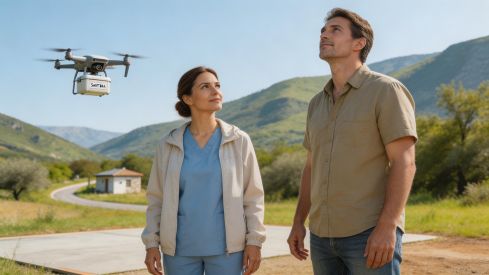
The sanitary transport with drones between the Comarcal Hospital of Pallars, in Tremp, and the Arnau de Vilanova Hospital of Lleida will begin to operate this summer. The Generalitat foresees that this regular service will allow the sending of blood bags, biological samples, pharmaceuticals and medical material to rural and mountain areas of the province of Lleida.
Reduction of times and emissions on the Tremp-Lleida route
The air journey between Tremp and Lleida will have a duration of between 40 and 45 minutes, compared to the current approximately 75 minutes by road. The transfer time will be reduced by almost half, which can be key in emergency situations and in the preservation of medical samples.
The initiative foresees a 98% reduction in CO₂ emissions compared to conventional transport. Furthermore, the project managers estimate that the system will allow to decrease up to 50% the degradation of biological samples during the journey.
First sanitary corridor with drones in the Alt Pirineu i Aran
The service will be regular, although it will also allow unscheduled flights and attend to on-demand requests. This first connection will be launched in the health regions of Lleida and Alt Pirineu i Aran, where new corridors are being studied for the transport of biological samples, drugs, and medical equipment.
Currently, the air corridor project between Lleida and Tremp has passed the first technical and safety phase. The advanced authorization necessary to open regular routes is being processed before the State Air Safety Agency. The authorization is expected from summer onwards and, when it arrives, the first drone flights will begin.
Pilot tests and system expansion
Since 2023, the Generalitat has carried out two pilot tests to analyze the potential of drones in healthcare logistics. One of them was carried out in Garrotxa and another in the Metropolitan North Health Region. The results confirmed the technical and healthcare viability of the system. According to the data obtained, transport time was reduced by more than 70% and CO₂ emissions dropped by 98%. In Garrotxa, sample degradation decreased by approximately 50%. In the metropolitan area, samples arrived in optimal conditions and were not affected by road surface irregularities.
A report on the integration of drones into the health system has identified ten strategic zones with fifteen hospitals where it is viable to deploy healthcare logistics routes in the short and medium term. Among the connections under study are the routes between Tremp, Sort, and Vielha and their respective healthcare centers.
Institutional and technological collaboration
The project is led by the Department of the Presidency, through the Centre for Telecommunications and Information Technologies, and by the Department of Health, through the TIC Health and Social Foundation. Also participating are the Blood and Tissue Bank, responsible for validating the transport of blood components, T-Systems as a technological collaborator, and Pirineos Drone as a flight operator.
The initiative is part of the GovTech Catalonia Program, which promotes collaboration between the Administration and the technological ecosystem to respond to public challenges in the health and logistics fields.
The deployment of medical drones in Tremp and Lleida marks an advance in medical logistics in rural and mountain areas, with a direct impact on the speed of transfers and environmental sustainability.