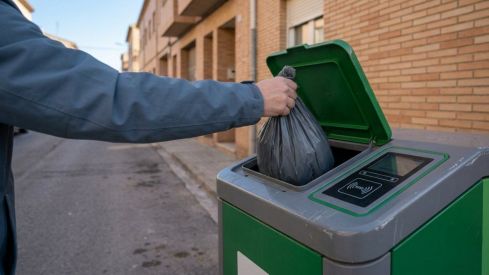
Four out of every 10 inhabitants of the province of Lleida already use efficient selective collection systems, with door-to-door models or identified smart bins. The rollout is progressing in dozens of municipalities, but in the capital, the change barely reaches about 3,000 residents in Ciutat Jardí and Vila Montcada.
The difference also appears in the results. While the implementation is extending to regions such as La Segarra, El Urgell, El Segrià, or El Pallars Sobirà, in Mollerussa the residual fraction still represents 52% of the total, far above the theoretical target of 16%, with the consequent increase in costs and penalties.
Door-to-door already operates in 93 municipalities and serves 132,000 residents
The Agència de Residus de Catalunya places the number of Lleida municipalities that have implemented the door-to-door system at 93. In total, it serves about 132,000 residents spread mainly across La Segarra, El Urgell, El Segrià, and El Pallars Sobirà.
During February, four municipalities in El Pallars Jussà, Pobla de Segur, Salàs, Talarn, and El Pont de Claverol, as well as Bellpuig and 16 towns in Les Garrigues, were incorporated. Les Borges Blanques will be added to that map in June.
There are also local variations. L'Albagés applies its own model with artificial intelligence, while Lleida city maintains door-to-door on a much more limited scale, restricted to about 3,000 residents in the Ciutat Jardí and Vila Montcada neighborhoods.
Locked bins already cover more than 62,000 residents
The other major implementation route is smart or locked bins, active in 46 towns and covering more than 62,000 residents. The main concentration is in La Noguera, with 30 municipalities, and in L'Alt Urgell, with 10.
The system also operates in Gósol, in Berguedà, and in Riu de Cerdanya and Montellà i Martinet, in Cerdanya. In El Pla d'Urgell, it has been deployed in Vilanova de Bellpuig, Sidamon, and El Palau d'Anglesola.
In El Solsonès, the comarcal council will install smart bins in most municipalities. Sant Llorenç de Morunys, La Coma i la Pedra, and Guixers will be excluded from this scheme because they will implement a personalized door-to-door system, and Solsona, Torà, and Biosca are already working with smart bins under an agreement prior to their comarcal incorporation.
Mollerussa raised selective collection to 47%, but the residual fraction remains at 52%
Mollerussa closed 2025 with a selective collection of 47%, above the 45.27% of the previous year. The progress came in a year in which the total generation of waste increased by 7.7% to 7,894 tons.
Marc Solsona, mayor of Mollerussa, warned that the residual fraction remains far from the expected level. The mayor pointed out that the residual fraction still represents 52% of the total, when the theoretical objective is 16%, a difference that entails penalties and increases the cost of the service.
The municipality also faces a change of cycle in management. The current collection concessions end this year and the city council is working with the comarcal council on the review of mixed models that allow for a reduction in the residual fraction and cost adjustments.
As an immediate measure, the Mollerussa town hall will double the intensive cleaning of the container islands every fifteen days, compared to the monthly frequency applied until now.