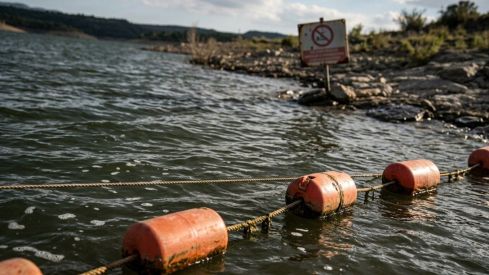
The Ebro Hydrographic Confederation has recalled the prohibition of bathing in areas around dams, canals, and reservoirs due to the risk of currents and whirlpools, at a time when the high temperatures of the second half of May have already led bathers to rivers and reservoirs in Lleida before the opening of many municipal swimming pools.
The warning also comes when there are a dozen official bathing areas in the demarcation between the Pyrenees and the plain. The difference between these delimited areas and other frequently visited spots is that outside the enabled areas there is not always complete signage or surveillance, even though the influx has already begun.
The CHE restricts bathing in dams and canals as the influx into rivers and reservoirs grows
The organization has issued the warning following the deaths of two women in the Baños de Cerrato reservoir, in Palencia. The CHE insists that users should only use the official bathing areas delimited by the competent administrations at the beginning of the season.
The water law does not require authorization to bathe in rivers, lakes, or reservoirs. Nevertheless, the confederation recalls that these areas have inherent risks due to currents, whirlpools, and changes in water behavior.
In river sections with hydroelectric power plants, the flow can vary suddenly. The CHE points out that this danger is usually indicated by warning signs in the affected areas.
Lleida adds a dozen official areas and Camarasa expects to mark risky spots with buoys
Lleida has a dozen official bathing areas spread between the Pyrenees and the plain, mostly managed by the town councils. During July and August, the Catalan Water Agency monitors the sanitary quality of the water in these areas to check that they comply with the European directive on bathing water regarding fecal contamination.
As this calendar progresses, some enclaves are already receiving visitors. La Platgeta de Camarasa registers some attendance, as explained by the Councilor for Tourism, Elisabet Lizaso.
"In the coming days, the firefighters will come to mark with buoys the areas where it may be dangerous to bathe" - Elisabet Lizaso, Councilor for Tourism, Camarasa Town Council
Lizaso has also acknowledged that the city council cannot prevent some users from crossing those safety buoys because there are no lifeguards in the area. This lack of surveillance is repeated in other parts of the territory that receive bathers with the rise in temperatures.
There is no lifeguard service on the Rialb river, in the Torrassa de la Guingueta d'Àneu, nor on El Xiringuito beach, between La Pobla de Segur and Conca de Dalt.