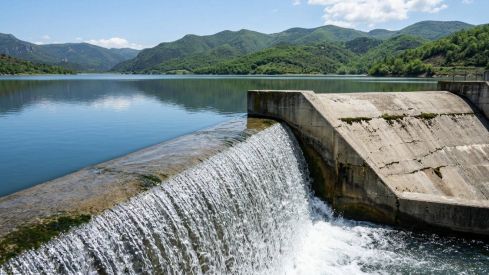
The reservoirs of the Lleida demarcation face the summer above 85% of their average capacity and with enough water for the population's consumption and the unrestricted irrigation campaign. The recovery affects the main systems of the basin and leaves behind two years marked by historic lows.
The contrast is especially visible in Rialb and Canelles. In September 2022, Rialb fell below 5% and barely retained 20 cubic hectometers, while Canelles dropped below 15%, halted tourist activity in the Congost de Mont-rebei, and preceded the historic closure of the Canal de Urgell in May 2023, with crop losses.
Rialb is close to full and Oliana consolidates the improvement of the Segre
Now, the Rialb reservoir stores 397 cubic hectometers, which is equivalent to 98.2% of its total capacity. Oliana, downstream, reaches 96.4% with 81 cubic hectometers, a level that reinforces availability for irrigation and supply systems.
The Ebro Hydrographic Confederation attributes this recovery to winter rainfall and spring snowmelt in the Pyrenees. The improvement began to be noticeable in the spring of 2024, when Rialb already exceeded 29%, and was consolidated in the summer of 2025 with sufficient reserves for the agricultural campaign.
With these volumes, the Urgell and Segarra Garrigues systems will be able to operate without limitations during the summer. The change comes after the drought of 2022 and 2023, when the lack of water forced restrictions and altered irrigation planning in a large part of the Lleida plain.
Canelles returns to 85% and Mont-rebei recovers kayaking
In the Noguera Ribagorçana, Canelles is at 85% with 578 cubic hectometers stored. This level allows for the resumption of activities such as kayaking and hiking in the Congost de Mont-rebei, which was severely affected when the reservoir fell below 15%.
Santa Anna maintains stable records within the same trend. In the Noguera Pallaresa basin, the Tremp reservoir, in Talarn, is at 99% with 225 cubic hectometers, while Terradets shows practically maximum levels to ensure summer supply.
Camarasa retains 129 cubic hectometers after releasing water to control flows due to rain and snowmelt. Even so, the system maintains sufficient margin at the end of May.
The highest data on the network corresponds to the Tremp reservoir, in Talarn, which reaches 99% capacity with 225 cubic hectometers stored.