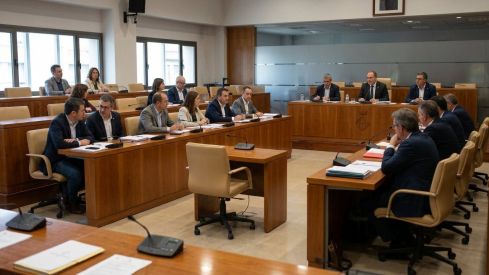
The Lleida municipal plenary session has initially approved the new Municipal Urban Planning Plan (POUM), a strategic document that will define the city's growth model for the next twenty years. The regulation has received the support of the PSC government, added to the votes of the Partido Popular and Junts per Catalunya, forming a solid majority that allows for the promotion of territorial transformation. This agreement has had the abstention of Esquerra Republicana and Vox, while Comú has issued a negative vote considering the text insufficient.
The approval marks the beginning of a process that foresees a significant expansion of the urban and productive fabric. The City Council highlights that the document will allow the construction of up to 34,185 new homes, a key figure to respond to the accumulated housing demand. The planning includes the following structural axes
- Development of 600 hectares dedicated exclusively to industrial land.
- Creation of 11,257 jobs linked to the new economic fabric.
- Maximum projected population figure, which would rise to 212,938 inhabitants.
- Integration of strategic projects such as the station plan, the transfer of the Fira, and the redevelopment of Turó de Gardeny.
Political debate and territorial projection
The deputy mayor, Begoña Iglesias, has defended the result as a balance between the necessary progress and the protection of the environment.
"It is the POUM of consensus, the one the city needs, the one of growth, the one of the preservation of l'Horta and housing"
Iglesias has underlined the critical need to release public land, recalling that the current availability is limited to 11,000 square meters in the Torre Solé industrial estate, all of them privately owned. The opposition leader, Xavi Palau, has described the document as essential for its technical rigor.
"It provides ideas on housing, industrial land, and technical reasons that make it impossible to say no at a political level"
Junts per Catalunya has supported the initiative after incorporating significant improvements for its electorate. Violant Cervera, spokesperson for the group, has acknowledged that the amendments included satisfy their demands.
"Lleida cannot continue growing with the gaze of the last century and, with the contributions that have been included in the plan, we are satisfied"
However, the approval has generated friction in other blocs. Jordina Freixanet, from Esquerra Republicana, has criticized the quantitative logic of the plan.
"It is the POUM of square meters, but not of people, growing more does not mean living better"
Faced with this, Vox has opted for abstention without supporting the text. Gloria Rico has argued that the project moves away from its municipal proposal. Laura Bergés, from Comú, has voted against, calling the plan obsolete and alien to current challenges.
Agreements on the Torreblanca industrial estate and renewable energies
The plenary session has also closed other relevant agreements for municipal management. The creation of a collaboration agreement between the Paeria, the Chamber of Commerce, and the Generalitat to govern the future industrial park of Torreblanca has been approved. This figure has had the favorable votes of PSC and Vox, the rejection of Comú, and the abstention of the rest of the groups. The mayor, Fèlix Larrosa, has presented this mechanism as an unprecedented tool that will be adjusted as the parceling procedures advance.
In the environmental field, the council has maintained a united front against the expansion of energy facilities. The plenary session has unanimously approved a motion presented by the Lleida Platform against the MAT to object to the Territorial Sector Plan for the Implementation of Renewable Energies in Catalonia (PLATER). All groups have called for a sustainable and proportionate model, rejecting the disproportionate implementation that threatens the agricultural land of Segrià.
"Renewables yes, but not like this"
Adrià Drago and David Poca, members of the platform, have thus synthesized the neighborhood's concern over the loss of cultivable land. Furthermore, the plenary session has unanimously given the green light to a request from the neighborhood and retired associations of Secà de Sant Pere to permanently fence off the Juanjo Garra pavilion parking lot, with the government's commitment to study its feasibility. The creation of a temporary personnel program to manage aid from the Pla de Barris and the Integral Development Strategy has also been authorized, as well as the ERC's motion to improve the air conditioning in educational centers.
With these agreements, Lleida begins the period for objections to the POUM, a mandatory procedure that will open the door to provisional approval before the end of the year and will require the definitive endorsement of the Generalitat de Catalunya to come into effect.