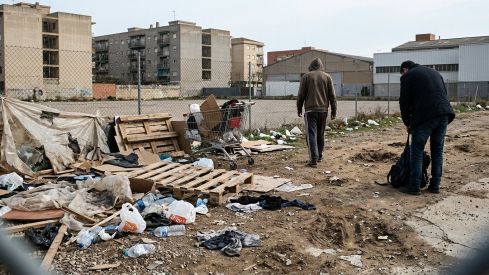
The social services of Lleida City Council have counted at least 117 homeless people who live on the street, in camps or in occupied buildings in poor condition in the city. The count has been carried out to monitor this population with the participation of security forces, intervention teams and volunteers.
Of the total detected, 30 people live on the street or in public spaces, 24 do so in camps or tents and 63 reside in occupied buildings in deficient conditions. The balance comes two weeks after the dismantling of one of the largest shantytowns in Lleida, on Josep Tarradellas avenue.
Recount after the dismantling of the Josep Tarradellas settlement
In that camp on Josep Tarradellas avenue there were at least twenty shacks built with wood and plastics. At the time of the eviction, at least five people resided there. The council has now released the global figure of homeless people located in the city as part of the continuous social and welfare monitoring it maintains.
The social educators who collaborate with the Igloo Plan had already noted this past winter an increase in the number of homeless people. That device, activated during the coldest months, has served this year 280 different people.
Accommodation resources and intervention reinforcement
La Paeria has 90 emergency accommodation places throughout the year for homeless people. Added to this are 93 stable accommodation places distributed among 37 Housing First homes, 30 places for young people and 22 in municipal homes managed by social entities.
During the winter, the City Council adds 70 more places within the Igloo Plan. The municipal government has also reminded that there are specific devices to attend to seasonal workers in summer.
In addition, the Paeria will enable the civic hubs of the Balàfia School and the Josefinas convent to attend to homeless people. It also plans to reinforce the street intervention teams throughout the year with the aim of improving detection and accompanying these people so that they can get out of this situation.
The City Council situates housing at the center of the response
"Early detection, individualized care, and the comprehensive approach to the causes of residential exclusion" - Carlos Enjuanes, Deputy Mayor for Social Action and Innovation
The Deputy Mayor for Social Action and Innovation, Carlos Enjuanes, framed these measures within the new social inclusion model of the Paeria. Along the same lines, he argued that the municipal response involves intervening earlier, strengthening follow-up, and expanding residential resources.
"One cannot conceive of cities where there are people sleeping on the street, our intention is for these spaces to cease to exist and to facilitate that everyone has a dignified home" - Carlos Enjuanes, deputy mayor of Social Action and Innovation
Enjuanes also added that "never before" had so much housing policy been made "as in the last 2 years". With this count on the table, the City Council now focuses on locating people who remain outside the residential system and on expanding social support to reduce homelessness in the city.