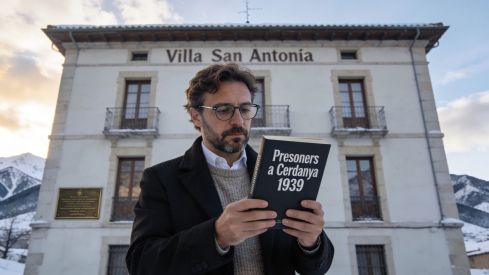
The Villa San Antonio of Puigcerdà was used as a Francoist concentration camp between February 1939 and December 1941, according to the research of Cerdanya historian Marc Pont Fitó. Thousands of Republicans who were returning to Catalonia through the Puigcerdà border after the Civil War passed through this space.
Identification of the space and function of the field
Marc Pont Fitó has located the exact location of the camp and has specified its main function. The compound, located in the current Villa San Antonio, served for the classification and redistribution of prisoners who crossed from France. From there, the inmates were sent to other camps such as Reus, Miranda d'Ebre or Cervera under the direction of the Inspection of Concentration Camps for Prisoners of the Franco regime.
"I had read that there had been a concentration camp in Puigcerdà, but I didn't know anything else, neither its location nor dates" - Marc Pont Fitó, historian
The camp was operational from February 17, 1939. On February 13 of that year, 918 people passed through in a single day, and the next day, 400 more. A municipal receipt documents the supply of 10,000 bread rations for the prisoners, suggesting a high concentration of inmates in short periods.
Figures and context of the repression
Reports from Francoist intelligence services estimate 83,000 people crossed Cerdanya during the Republican retreat. However, Pont Fitó himself warns that this data should be treated with caution.
"They are figures that we always put in quarantine, but it is the best we have from the sources" - Marc Pont Fitó, historian
Historical documents mention between 10 and 50 shot at the Pedraza wall, right in front of the field, after the entry of Francoist troops on February 10, 1939. At least one of the victims is identified and buried in the Puigcerdà cemetery.
Pending memory and recognition
Before being a concentration camp, Villa San Antonio was a colony for refugee children and a republican military hospital where about twenty wounded soldiers died. Currently, there is no plaque at the site to commemorate these events.
"There isn't a single plaque explaining what happened here. All of this has been buried"
The historian has initiated conversations with the Puigcerdà City Council to promote a commemorative plaque at Villa San Antonio. Pont Fitó highlights that there is still a lot of work pending in terms of democratic justice and historical memory in the area.
Research Dissemination and Presentation
On Friday, February 20, at 7 p.m., in the Sebastià Bosom Hall of the Cerdanya Regional Archive, in Puigcerdà, Marc Pont Fitó will give the lecture "Border, classification, repression and oblivion of the Francoist concentration camp of Puigcerdà". At the same event, his book "Prisoners in Cerdanya 1939" will be presented.