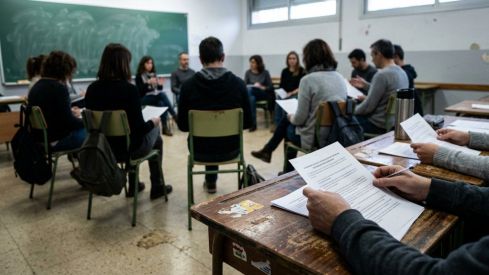
The education unions will decide on Saturday afternoon whether to maintain next week's mobilizations while teachers analyze the preliminary agreement reached on Friday night with the Departament d'Educació. The meeting comes with the strike still called in part of the territory and with the consultation of the bases still without a fixed date.
The main unknown is that the principle of agreement opens the door to a de-escalation, but USTEC maintains the strike on Monday for now in the central regions and in Girona. The union has linked any change to the result of a new consultation with its affiliates and to the joint debate with teachers.
USTEC maintains Monday's strike while postponing the consultation
Iolanda Segura, spokesperson for USTEC, explained that Saturday's meeting will serve to decide whether the strikes continue and how the consultation will be organized. The vote of the bases was initially planned for the weekend, although the union admits that it could be postponed until after Monday to facilitate a collective debate in the centers.
"What we will debate is whether the strikes are maintained and the calendar of the consultation itself" - Iolanda Segura, spokesperson for USTEC
Segura also defended that the decision must be made with the same criteria with which the conflict was called. USTEC maintains that, since the strike was called in a unified manner, it must also be jointly consulted whether a ceasefire is appropriate.
In its statement, the union stressed that the proposal includes very important advances achieved with teacher mobilization. Nevertheless, it left open the option of reactivating protests from June 8 if the bases do not validate the preliminary agreement.
The calendar still includes strikes in Barcelona, Tarragona and Lleida
If there are no changes, next week will begin with the strike day on Monday in the central regions and in Girona. Afterwards, strikes were planned for Tuesday, June 2, in the Consorci d'Educació de Barcelona and in metropolitan cities, on Wednesday in Tarragona and les Terres de l'Ebre, and on Thursday, June 4, in Lleida and Alt Pirineu i Aran.
That calendar culminated in a general strike and a demonstration in Barcelona. The continuity of that plan will depend on what the unions agree on and the response that teachers give to the consultation on the pact with the Generalitat de Catalunya.
Esther Niubó, Minister of Education and Vocational Training, acknowledged that she cannot guarantee the cancellation, although she trusts that it will eventually happen. Niubó recalled that the agreement has the support of four out of the five unions with representation on the sectoral committee and pointed out that the final decision corresponds to the organization of each call.
CGT rejects an offer that raises the new bonus to 173 euros
CGT-Intersindical has distanced itself from the pact and considers the offer from the Department of Education insufficient. Laura Gené, spokesperson for the union, regretted that the proposal does not include issues that her organization considers minimal, despite incorporating 50 euros more than previously proposed for the newly created bonus.
Looking ahead four years, the new bonus will reach 173 euros. Added to the 30% increase in the specific bonus and state increases, the calculation presented by the signatory parties places the increase at approximately 600 euros gross per month for teachers.
The pre-agreement also includes the recovery of back pay for the six-year increments over five years. This seniority bonus was paid every six years until 2012 and began to be received every nine years during the cuts.
Along with the pay increase, the proposal includes the call for 5,000 places for secondary school teachers in two years. The planned distribution is 2,500 places next academic year and another 2,500 in the following one, in addition to 6,413 places for inclusive education that will be rolled out progressively until the 2029-2030 academic year.