Public schools and institutes in Girona will face up to 43 school days in 2030 with temperatures above the thresholds that the Equitat.org report considers risky for school activities. The projection places the city among the most exposed Catalan capitals, only behind Lleida.
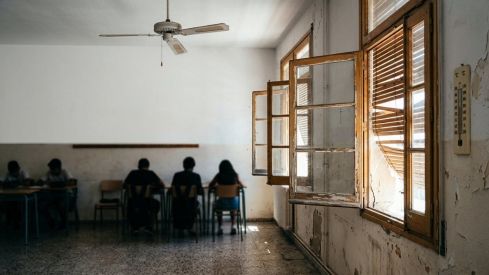
The mismatch, according to the foundation, is that part of the educational network continues to operate in buildings designed for a climate that no longer exists. As days with high temperatures rise, more than 1,200 Catalan public centers awaiting renovation drag deficits in insulation, ventilation, or air conditioning.
Girona will be close to a quarter of the course with high heat in 2030
The study Heat at school. How to adapt educational centers to the country's new climate calculates that Girona will have 42 school days with an outside temperature above 26.7 degrees and 43 with a heat index above 27 degrees. In a school year of 175 days, this is equivalent to 24% and 24.6% of the school calendar.
In the rest of the capitals, the projection for 2030 is lower in Barcelona and higher in Tarragona and Lleida. The Catalan capital would register 16 days above 26.7 degrees and 22 with a heat index above 27, Tarragona would reach 42 and 49 days, and Lleida 63 and 65.
Girona will have 42 school days above 26.7 degrees in 2030.
The foundation maintains that the problem is not limited to specific end-of-term episodes. The report links daily exposure to outdoor temperatures equal to or greater than 26.7 degrees with a 0.18% drop in student scores on PISA tests.
Ismael Palacín, director of Equitat.org, focused on the state of the school infrastructure during the presentation of the report.
"The country's schools were designed for a climate that no longer exists" - Ismael Palacín, director of Equitat.org
Palacín added that postponing the adaptation implies accepting that thousands of children, young people, and teachers study and work in spaces that compromise their health, their well-being, and their learning.
Girona activates GiroNat while Equitat.org estimates adaptation at up to 1.3 billion
Faced with this scenario, Girona is already developing the GiroNat project, endowed with 3.2 million euros and financed with Next Generation funds. The program seeks to renaturalize schoolyards and turn them into climate refuges through diagnosis, participatory co-design, and teacher training.
More than 1,200 Catalan public centers are still pending rehabilitation.
Equitat.org proposes an immediate shock plan with rapid implementation measures in the centers. Among them are ceiling fans, night or morning ventilation, natural or bioclimatic shading, water fountains in the courtyards, and air-conditioned spaces at strategic points in each school or institute.
In the medium term, the foundation calls for a five- to ten-year climate adaptation plan for the Catalan public network. The estimated cost for this reform ranges between 500 million and 1.3 billion euros, a range that, if spread over a decade, amounts to between 45 and 130 million annually.
The calculation by Equitat.org places the investment at around 200 euros per student per year.