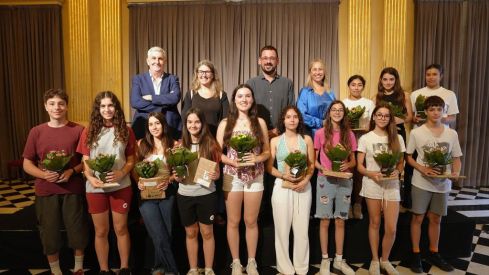
The Girona City Council has presented this Thursday the awards for the 46th edition of the Secondary School Floral and Literary Games Competition in the Rest Room of the Municipal Theater. One hundred compositions from nine educational centers in the city participated in this edition, and nineteen students received an award.
The call maintains a Catalan school literary tradition almost 175 years after the birth of the first Floral Games, a continuity that the mayor of Girona, Lluc Salellas i Vilar, contrasted with the context of its origins, when it was thought that this language would not continue in such events.
Nineteen students received awards among one hundred compositions from nine centers
Lluc Salellas i Vilar and the Councilor for Statistics and Citizen Services, Education, and Participation, Queralt Vila i Vergés, attended the event. The ceremony brought together the awarded students from the different categories of poetry and prose, from the first cycle of ESO to the post-compulsory stage.
In the first cycle of ESO, J. Callol, from Institut Ermessenda, won the Natural Flower, while P. Masó, from Institut Jaume Vicens Vives, obtained the Eglantine and X. Sleep, from Institut Santiago Sobrequés i Vidal, the Violet. In prose, B. Ferran, from Institut Santiago Sobrequés i Vidal, achieved first prize, ahead of R. Ordis, from Vedruna, and N. Calabria, from Institut Ermessenda.
In the second cycle of ESO, A. Darbra, from Institut Ermessenda, won the Natural Flower, M. Paéz, from La Salle, the Eglantine, and S. Ruffo, from Vedruna, the Violet. In prose, C. Doltra, from Institut Santiago Sobrequés i Vidal, obtained first prize and second place was a tie between A. San Esteban, from Montessori Palau, E. Martí, from Institut Santiago Sobrequés i Vidal, and A. Costal, from La Salle.
In the post-compulsory stage, L. Montserrat, from Institut Ermessenda, won the Natural Flower, A. Sánchez, from Institut Santiago Sobrequés i Vidal, the Eglantine, and A. Bonaset, from Maristes, the Violet. In prose, D. Rios, from Montessori Palau, obtained first prize, X. Casares, from the same center, came second, and M. Puigdemont, from Vedruna, third.
Salellas linked the continuity of the awards with reading and writing in Catalan
Lluc Salellas i Vilar framed the ceremony within the history of the Floral Games and the role of writing in the education of young people.
"When the first Floral Games were organized, it had been so many years since anyone had written in Catalan that they thought it would be the last act in this language. Fortunately, they were very wrong. Almost 175 years later, these awards continue to exist and we hope they will for many more years" - Lluc Salellas i Vilar, mayor of Girona
The mayor added that reading and writing allow one to maintain critical thinking, not to be carried away by trends, and to have a refuge to stop and organize ideas. Queralt Vila i Vergés, for her part, argued that the competition fosters creativity, critical thinking, and literary expression among the city's youth.
Artistic baccalaureate students from the Institut Santiago Sobrequés i Vidal also participated in the event, providing the music for the award ceremony. The writer Mar Bosch closed the ceremony by encouraging the students to continue developing their creativity and thanking the teaching staff for their involvement in promoting writing.
The jury for this 46th edition consisted of Mercè Pons, from the Municipal Library Service, Mar Bosch, Dolors Serrano, a professor at the Institut Jaume Vicens Vives, Mariàngela Vilallonga, representing the Faculty of Letters of the University of Girona, Lluís Hernández, representing the Territorial Services of Education in Girona, and the councilwoman Queralt Vila i Vergés.