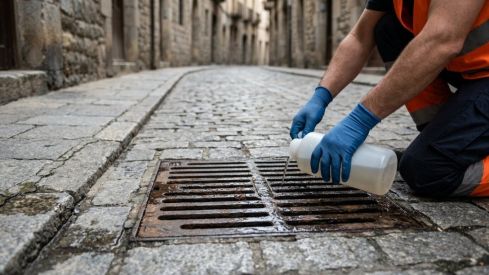
The Girona City Council has launched this week the annual tiger mosquito control campaign with biocidal treatments at strategic points on public roads. The first round began on May 25, after a period of rain and rising temperatures that favors the proliferation of this insect.
The action seeks to reduce the nuisance of bites and, at the same time, lower the risk of transmission of tropical diseases such as dengue, chikungunya, or the Zika virus. The municipal reinforcement comes at a time when a good part of the breeding grounds still depend on prevention on private properties and daily habits such as not leaving stagnant water.
The campaign will treat 14,143 breeding sites in drains and grates
The operation is part of the Tiger Mosquito Monitoring and Control Program in the Girona demarcation and will be repeated periodically in May, July, and September. The work focuses on 14,143 breeding sites detected on public roads.
The awarded company, ANTICIMEX 3D SANIDAD AMBIENTAL S.A.U., will apply a low-toxicity larvicide, especially in drains and drainage grates. In addition, it will install monitoring traps in all neighborhoods to track the evolution of the mosquito population.
In parallel, the municipal pest control brigade will inspect and treat the drains located in the interior courtyards of municipal facilities, including schools and cemeteries. During the summer, it will also place specific traps in high-risk areas, such as centers where summer camps are held.
Gemma Martínez asks to avoid accumulated water in homes and businesses
The Councilor for Caring City and Environmental Services and Animal Welfare, Gemma Martínez Villagrasa, frames the campaign within a strategy that combines municipal intervention and neighborhood prevention.
"From the City Council, we are reinforcing tiger mosquito control with treatments on public roads and in municipal facilities, but prevention also requires citizen involvement" - Gemma Martínez Villagrasa, Councilor for Caring City and Environmental Services and Animal Welfare, Girona City Council
Martínez added that avoiding small accumulations of water is key to preventing mosquito breeding. She also maintained that reducing its presence is a shared responsibility with direct effects on public health, coexistence, and quality of life in the neighborhoods.
The council will disseminate educational material in civic centers, senior centers, libraries, and primary care centers. To this campaign, it will add messages on social networks and talks or workshops in neighborhoods that request them.
The tiger mosquito remains active until November and gains strength between August and October
Municipal surveillance will focus on the months of greatest insect activity. The tiger mosquito is present between mid-April and mid-November, although its incidence increases especially between August and October.
In addition to ordinary treatments, the awarded company will act in cases linked to declarations of arbovirosis, in accordance with the Catalan protocol for the surveillance and control of mosquito-borne diseases. The first round this year started after recent rains and a rise in temperatures.
The City Council reminds residents and businesses to avoid leaving containers or objects with accumulated water on their properties, a gesture that can stop mosquito breeding in the private sphere where municipal treatment does not reach.