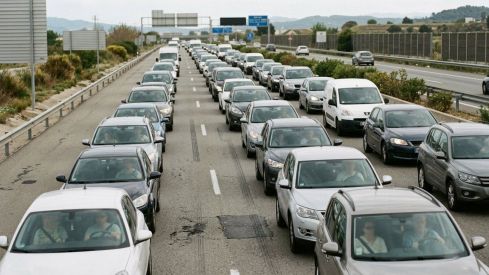
The Servei Català de Trànsit has declared the May 1st bridge exit operation concluded with a balance that confirms high mobility in departures from the Catalan capital. Between 12:00 PM yesterday and 3:00 PM today, 575,651 vehicles have left the metropolitan area of Barcelona out of the 580,000 planned, representing 99% of the estimated traffic for this holiday period.
First operation after Holy Week concentrates mixed flows
The road authorities explain that this figure, so close to what was foreseen, responds to specific calendar factors. As it is the first special operation after Easter and coincides with the beginning of the month and an already advanced spring, drivers have distributed their trips both towards coastal destinations and towards inland towns, thus avoiding an exclusive concentration in a single direction.
AP-7 registers kilometers of traffic jams in both directions
The main transversal axis suffered important pressures throughout the course of the day. The AP-7 accumulated several kilometers of traffic jams in both directions of circulation. Heading towards Girona, the most critical points were located in Mollet del Vallès, La Roca del Vallès and the stretch between Llinars del Vallès and Sant Celoni. The flow towards Tarragona also showed severe problems, with more than ten kilometers of congestion recorded between Castellví de Rosanes and Castellbisbal, along with a queue of over seven kilometers between Castellet i la Gornal and Olèrdola.
The traditional accesses to the Costa Brava concentrated the greatest traffic complications during the departure. The peripheral road network registered significant stops on the C-35 and C-65, especially between Llagostera and Cassà de la Selva towards Sant Feliu de Guíxols. The N-II maintained persistent difficulties between Tordera and Vidreres, while in the Eastern Pyrenees area the C-17 experienced notable congestion in the municipality of Ripoll.
With this latest count, the competent body has definitively closed the management of the festive exit. The data reflect a massive controlled mobilization that allowed the evacuation of almost all estimated vehicles despite the occasional tensions detected at the main and secondary access nodes in the Catalan geography.