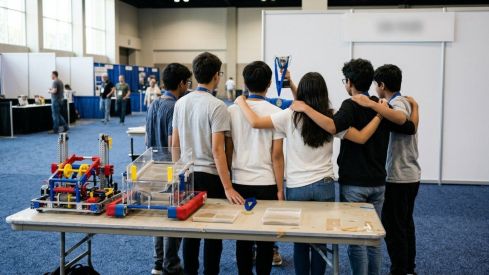
The Robotech team from Mollerussa was proclaimed world champion of the First Lego League in the final held in Houston. The six Catalan students achieved the title after defeating the best international teams in robotization and innovation.
The victory consolidates a journey that began with the triumph in Lleida and continued with the qualification in the state phase of Burgos. There, the Mollerussa group obtained one of the three available spots for Spain along with the Navarrese teams FS Ingenium and Legatonic Beavers from Pamplona.
A technical solution for archaeology
The innovation project addressed a real problem detected after consulting more than 460 archaeologists. These experts pointed out the existing slowness in the manual processes of sediment separation during excavations.
The young people developed a machine capable of accelerating the classification of remains mixed with soil. The system employs flotation with liquids of different densities and screens of various sizes to speed up fieldwork.
"they told us they could keep it because they thought it was a fantastic idea to implement in their laboratory" - Àneu Tarragó, student from the Robotech team
The presentation of the proposal took place at the Universitat de Lleida. The center's staff positively valued the practical utility of the invention and showed interest in its immediate application. The technology created by the students is currently in the patent application process to protect the intellectual property of the development.
Self-taught with more than 3,000 hours of work
The group is formed by Àneu Tarragó, Abril Armengol, Sergi Civit, Oriol Roure, Marc Perera and Julià Domingo. Their ages range between 13 and 17 years old and they stand out for working without an academy or external coach.
This formative independence has meant a considerable workload for the members. They accumulate more than 3,000 hours of collective effort to perfect both the robot and the research project.
In the field of robotics, they improved the precision and agility of the automaton through a relevant technical change. They replaced the block programming usual in these competitions with Python language. This decision allowed for more reliable and efficient movements during the championship tests.
"It's what makes us unique" - Abril Armengol, student from the Robotech team
The combination of technical autonomy and scientific rigor defined their participation in Texas. The team members themselves attribute the success to the consistency shown during months of intensive preparation without direct professional supervision.
The reaction to the final verdict reflected the intensity of the competitive moment. The students described the announcement of victory as an instant of absolute euphoria after confirming the world's first place.