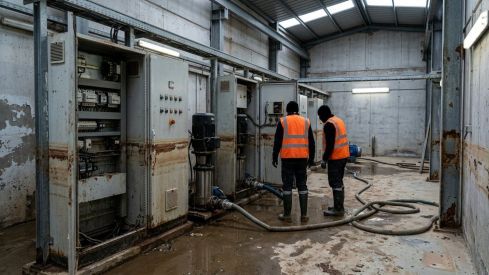
The Palamós treatment plant was completely disabled after the passage of storm Harry, which flooded the facilities with more than two meters of water inside. The managing consortium expects to recover the complete treatment of wastewater by the end of June.
The objective is to be operational before the start of the high tourist season. The plant serves Palamós, Calonge i Sant Antoni, Mont-ras, Vall-llobrega, Palafrugell and the nucleus of Sant Joan, in Baix Empordà.
The operators dived among the broken machinery
The torrential rains of January 19 and 20 unleashed up to 187 liters per square meter in the Torrent area. The ground was already saturated from the previous Sant Esteve downpour, which caused the collapse of the infrastructure.
"There were workers from this Palamós treatment plant who went out diving at night because there were more than two meters of water inside the entire treatment plant" - Miquel Noguer, president of the Diputació de Girona and of the Consorci d'Aigües Costa Brava Girona
Miquel Noguer described the extreme situation that the maintenance staff experienced. Nothing was working in the plant after the massive influx of water, which affected electrical panels, pumps, motors, transformers, and internal facilities.
The total cost of the damages amounts to 3,094,000 euros. The recovery will be carried out in phases to minimize the environmental impact during the works.
The repair of the outfall depends on the sea state
In mid-May, it is planned to restore the electrical supply and activate the primary clarifiers. This measure will reduce the polluting load discharged into the sea by approximately 40% while major repairs continue.
The consortium must also fix the submarine outfall of Cala Castell. Technicians detected a break on March 21 at 634 meters from the coast and at 23 meters of depth.
A custom-made piece manufactured in Denmark will arrive the last week of May. The installation was scheduled for the first week of June, provided that weather conditions allow it, with an estimated cost between 200,000 and 250,000 euros.
Starting June 15, the commissioning of biological treatment and secondary settling will begin. If no new setbacks arise, the system will reach its full capacity by the end of the month.
The complete treatment should place the reduction of suspended matter at around 95%. This figure represents the normal operating standards of the plant before the flood.
The analyses carried out by the Catalan Water Agency and the consortium confirm that bathing quality has not been compromised. The controls of March 23, April 3, and April 29 classify the water as excellent category.
- Playa de Castell: 20 NMP/100 ml of E. coli and 31 of intestinal enterococci.
- Castell Sud: 41 NMP/100 ml of E. coli and 74 of intestinal enterococci.
- La Fosca: 10 NMP/100 ml of E. coli and 20 of intestinal enterococci.
All values are well below the excellence limit of 250. Noguer insisted on the need to accelerate repairs without neglecting health surveillance.
"We will continue to carry out these water checks, but above all we must ensure that this can be repaired as quickly as possible" - Miquel Noguer, president of the Diputació de Girona and the Consorci d'Aigües Costa Brava Girona
The storm Harry caused eleven additional breakdowns in sanitation systems on the Costa Brava. In the northern area, which includes Colera, Llançà, El Port de la Selva, Cadaqués, Roses, and Palau-saverdera, the damages amount to 141,480 euros.
Roses presents a breakdown in the promenade system that affects a rainwater overflow return pipe to the submarine outfall. The central area, with incidents in l'Escala, Pals, and Begur, adds up to 149,580 euros in costs.
In L'Escala a pump from a well broke last weekend, an incident already resolved according to the consortium's president. The southern area, limited to Tossa de Mar, registers damages worth 15,470 euros.