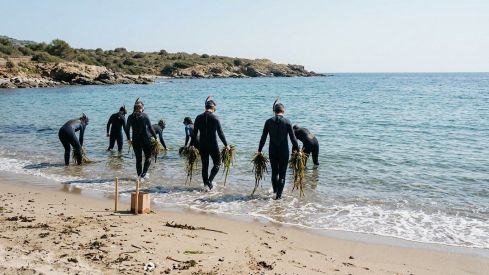
About thirty volunteers have recovered this Sunday dozens of bundles of posidonia that had been left adrift after the last storms on les Canyelles beach, in Llançà. The action has been organized by Submon as part of a day focused on locating the fragments torn off by the waves and removing them from the water to attempt their subsequent replanting.
The participants have equipped themselves with wetsuit, goggles and snorkel before entering the sea, after a prior briefing. The activity has also included an explanation about the ecological role of posidonia, indications about what bundles should be collected and an introduction to the characteristics of the Albera, the space where this beach of the Gerundense coast is located.
Replanting scheduled for this Monday
The collected bundles will be selected and, if they meet the adequate conditions, Submon technicians will replant them this Monday. The objective of the day had been set to recover a maximum of six bundles of posidonia torn out by the storms of recent months, although during the operation dozens of fragments were located adrift.
Andreu Dalmau, head of projects of the entity, has recalled that the force of the sea during storm episodes can uproot specimens of this marine plant.
"When there is a storm, the movement of the water is intense, and species like posidonia slow down this force. This causes some specimens to be uprooted" - Andreu Dalmau, head of projects at Submon
Dalmau has warned that it is a complex process. The recovered specimens have already suffered prior stress from being uprooted and remaining several days adrift, so now it will be necessary to check if these fragments are capable of re-rooting, growing, and expanding horizontally.
A slow process with long-term follow-up
The head of Submon has stressed that the recovery of posidonia requires time. He has explained that it will take at least between five and ten years to check the rooting and development of the replanted specimens. He has also insisted that the focus must be placed on passive restoration because it is a very slow-growing plant and, therefore, its recovery also is.
The technicians also recall that only entities authorized by the Generalitat can carry out active replanting activities like this one. The intervention seeks to reinforce a species that acts as a natural barrier against the waves thanks to its long leaves and the clumps it forms, with a direct role in the protection of the coast.
Outreach and protection of the marine environment
The day is framed within the European project Blue Connect, focused on improving management in protected marine areas. In the case of the Albera Marítima, Submon manages this project, which also includes the proposal of the municipalities of Llançà, Colera and Portbou to create a natural park that incorporates the marine space of this stretch of the Costa Brava.
Dalmau has remarked that posidonia is a key species in climate change mitigation due to its capacity to capture and store carbon dioxide in the sediment, in addition to contributing to oxygenating the water. His message has been clear in defending the need to preserve it.
"If it disappears from here, it disappears from the world" - Andreu Dalmau, project manager at Submon
The activity has also had an informative aspect aimed at the local population. Among the participants was Pecu, a volunteer from Palafrugell who was especially interested in outreach and environmental restoration. Maria and Miquel, from Baix Llobregat, also joined, who signed up because it seemed like a very attractive activity to them and they wanted to better understand their environment. The day has thus served to combine the collection of uprooted bundles with awareness-raising about the importance of a fundamental plant for biodiversity and coastal conservation.