The military escalation in the Middle East, with the exchange of attacks between the United States, Israel and Iran, has once again put the focus on the Strait of Hormuz, one of the most sensitive energy routes on the planet. Through that maritime passage circulates 20% of the oil and natural gas that supplies the global market, so that any threat of blockade has an almost immediate impact on energy markets worldwide.
That scenario is already noticeable in the pocket. During recent weeks, fossil fuels have become more expensive and have registered increases that approach 30% in moments of greatest tension. Transport is, as of today, the area that most clearly shows this effect.
The gasoline and the diesel return to strain the daily expense
The price of gasoline remains constantly above 1.56 euros per liter. In the case of diesel, the impact is even greater and the liter already approaches 2 euros, which places it as the most penalized fuel in this context of international instability.
Although Spain's direct dependence on supplies crossing the Strait of Hormuz is relative, the energy market does not function in isolation. The price of oil and gas is set according to global supply and demand. That means that, even with guaranteed supply, the cost of electricity and fuels remains exposed to any geopolitical shock.
Less direct dependence, but same exposure to the global market
The magnitude of the problem has led to considering this episode as one of the most important energy shocks in history. Electricity, in that framework, presents a less volatile evolution than that of oil, which opens room for domestic strategies aimed at containing the energy bill.
With that objective, gaining control over household spending becomes a priority. One of the proposals put forward is based on the Eco tool, a virtual advisor designed to facilitate the reading of electricity bills and organize consumption information in a more comprehensible way.
- Annual comparison
- Consumption detail
- Personalized economic profile
The electric car gains ground amidst the pressure of fuels
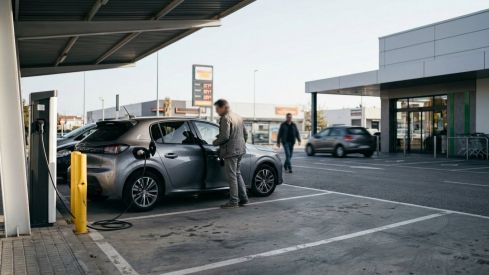
The rise in gasoline and diesel is also reinforcing interest in mobility formulas less exposed to crude oil prices. Sales of electrified vehicles rose by 62.5% in March, a trend that coincides with the deterioration of traditional fuel prices.
In that change of habits, one of the options proposed is a specific tariff for electric car charging that concentrates consumption in the most economical time slot. That modality allows driving from only 2 € every 100 kilometers and is also presented with 100% green energy and zero CO2 emissions.
The pressure on Ormuz once again demonstrates that energy no longer depends only on what happens at home nor on the solidity of the national supply. It also depends on the pulse of the world, and that instability quickly transfers to refueling, to the electricity bill and to the daily decisions of thousands of households.