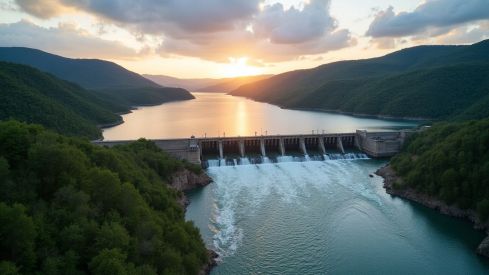
The reservoirs in the internal basins that supply most of the Catalan population are currently over 87% of their capacity, a figure that represents 39% more than the average for the last five years. This situation directly affects municipalities in Barcelona, Girona, and Tarragona, where the water supply depends heavily on these water resources.
Management of Discharges After the Flood
According to a statement from the Catalan Water Agency (Agència Catalana de l'Aigua), this volume has been reached after several days of operations to increase and reduce water releases, with the aim of minimizing the effects of recent rainfall. Between January 15 and 19, the ACA increased water releases to absorb the water that fell in the river headwaters. Subsequently, starting Monday, the flow rate released was reduced to prevent the rivers from overflowing downstream of the dams, especially in areas where the rainfall associated with Storm Harry was concentrated.
Situation of the main reservoirs
- The Sau reservoir is at 97% of its capacity, while Susqueda is at 93%.
- The Darnius Boadella, Baells, and Foix reservoirs also exceed 80% of their capacity.
According to the ACA, the management of water releases has prevented the flow rate in the Ter river from increasing by at least 400 m³/s and in the Muga river by 90 m³/s. This control has been key to avoiding major incidents in the lower sections of these rivers.
Caution in sections with high water flow
The ACA reports that river flows are tending to normalize, although the recommendation of caution for citizens remains. There are still sections where water levels are higher than usual and may pose a risk in certain areas
"We ask for caution because some sections of the rivers still have high flows" - Spokesperson, Catalan Water Agency
The situation remains under surveillance and the evolution of the reservoirs will be decisive in water management over the coming weeks in Catalan territory