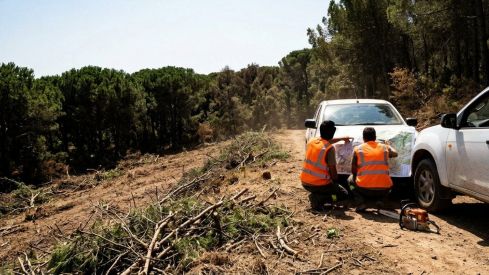
The Generalitat de Catalunya has presented a joint strategy from the departments of Interior, Agriculture, and Territory to prioritize the prevention of forest fires in Catalonia, with actions on forest mass, new protection strips, and the installation of photovoltaic panels at strategic points.
The plan starts from a premise that changes the usual approach. The Government assumes that it will not be enough to expand extinction resources because some fires predicted for the coming years may be beyond human capacity to extinguish them, in a territory where 65% of the surface is forest and the risk of sixth-generation fires is increasing due to climate change.
Parlon admits that some fires can overcome human extinction
The Minister of the Interior, Núria Parlon, defended that prevention must be approached with another approach and not just with more emergency resources. The strategy, in that line, seeks to reduce the continuity of the forest to slow the spread of large fires.
"We must approach prevention from a different perspective than simply providing more resources, because the characteristics of some fires in the future may be beyond the capacity of human extinction" - Núria Parlon, Minister of the Interior, Generalitat de Catalunya
Bombers de la Generalitat are already working with hypotheses of large fires capable of advancing from Osona to La Noguera or from Collserola towards the north of Maresme. On that basis, the Government plans to accelerate forestry work on some 34,000 hectares marked in red on the operational map.
The objective of these interventions is to prevent the fire from jumping from one massif to another. The strategy places the urban-forest interface as the first area of action, with protection strips around developments, inhabited areas, and sensitive infrastructures to protect lives and property.
Then will come the priority protection perimeters, identified as areas especially exposed to large fires. The third block focuses on 14 confinement axes where a mosaic landscape with crops, pastures, meadows, and open spaces will be reinforced.
The Government will place solar panels in areas where it removes forest mass
One of the planned measures is to install photovoltaic panels in strategic points where it is necessary to remove forest mass and maintain open spaces. The idea is to combine the difficulty of fire propagation with the production of green energy.
Òscar Ordeig, Minister of Agriculture, linked that action to the economic activity of the territory. In his approach, the strategy opens a way to connect fire prevention with employment and rural activity.
"An opportunity to boost the rural economy, generate employment, and promote a bioeconomy rooted in the territory" - Òscar Ordeig, Minister of Agriculture, Generalitat de Catalunya
The deployment will begin in public forests. Later, the Generalitat will also act on the confinement axes with private trees through agreements with owners or, if necessary, with direct actions with its own means.
In parallel, the operation plans to reinforce the emergency response with an expansion of the Firefighters to reach 4,000 personnel and with more prevention devices such as the GEPIF.