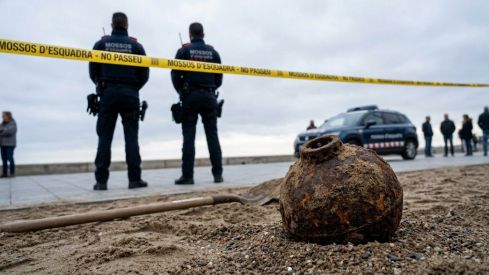
Works on the beach's seafront brought to light on Monday, around five in the afternoon, a rusted metallic object that forced the stoppage of work and the cordoning off of part of the promenade and the sandy area. The workers notified the Mossos d'Esquadra upon suspecting it could be an explosive device.
The intervention ended without detonation or risk to the population, but the find was not insignificant. The TEDAX of the Mossos d'Esquadra confirmed that the piece was a landmine from the Napoleonic era, dated between 1808 and 1814, located right on the maritime front.
The TEDAX confirmed that the mine was inactive
Local Police and Mossos d'Esquadra officers preemptively closed the promenade and the beach to guarantee the safety of pedestrians while specialists inspected the object.
The mine presented an advanced state of corrosion and had a hole with water inside. The technicians also checked that it did not retain any gunpowder residue, so they ruled out any risk of explosion.
The operation ended without a controlled detonation. Specialists neutralized the device by filling and emptying it with water during the intervention.
The piece weighs more than 80 kilos and was deposited in the Ciutadella de Roses
The artifact measures about 30 centimeters in diameter and weighs more than 80 kilograms. It also retains a perforated neck, a characteristic feature of this type of mine, through which gunpowder was introduced.
Due to its condition and age, the piece will be preserved as a historical and heritage element, once the danger that had motivated the deployment in the beach area has been ruled out.
Finally, the artifact has been deposited in the Ciutadella de Roses for its conservation.