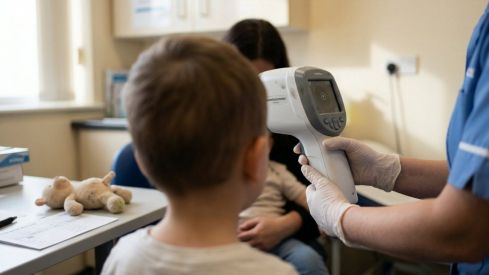
The Salt Primary Care Team has launched this Monday a pilot program for early screening to detect amblyopia in children aged 15 to 18 months. The test starts with an initial sample of 120 minors and is performed with a portable autorefractor during pediatric check-ups.
The change clearly advances the detection of possible visual alterations, which until now was usually done around three or four years of age, when children can already cooperate with optotypes. The objective is to locate at-risk cases earlier and refer them to pediatric Ophthalmology to confirm the diagnosis and start treatment as soon as possible.
Salt advances visual screening to children aged 15 to 18 months
Belén Pérez, deputy director of CSIR Salt, explained that the team has taken a pilot sample of about 120 children between 15 and 18 months old to apply this new test. The project is part of the center's actions as a Comprehensive Reference Health Center.
The Department of Health has selected 27 primary care teams to test new care models. In the Girona Health Region, Canet de Mar and Calella, in Alt Maresme, are also included.
The examination is done with a portable autorefractor capable of detecting refractive errors such as high hyperopia, myopia, astigmatism, or differences in prescription between one eye and the other. This first filter allows identifying cases that will later need to be reviewed in a specialized consultation.
"We have taken a pilot sample of about 120 children aged between 15 and 18 months to perform this test" - Belén Pérez, deputy director of CSIR Salt
Positive cases will go to pediatric Ophthalmology to confirm the diagnosis
When the screening yields a positive result, the minor will be referred to pediatric Ophthalmology. The team's intention is to intervene before the age at which these alterations were usually detected until now, when the margin for visual improvement may be greater.
Belén Pérez maintained that starting treatment at earlier ages improves visual prognosis. That is the basis of the pilot that the Salt CAP is now testing.
Among the first participating families is Fatumata Jabbi, mother of one of the minors included in the sample. The woman defended the usefulness of the test to detect any problem in time and act preventively.
"I think it's very important to do it to detect if there's something in time and be able to prevent it" - Fatumata Jabbi, mother of a participant
If the trial results are favorable, the center will incorporate the screening into the Creixent en Salut program within the 15-month check-up conducted by pediatric nursing. The device is already prepared to extend this coverage beyond the urban center.
Currently, the team has two autorefractors, one for the CAP of Salt and another to serve the local clinics of Vilablareix, Bescanó, Fornells, and Aiguaviva.