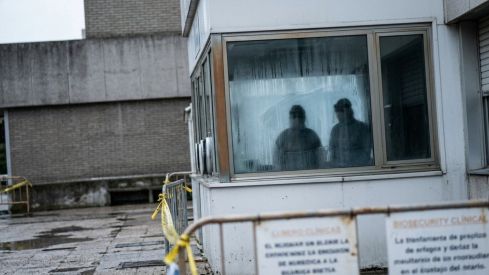
One of the 14 Spanish passengers from the MV Hondius cruise ship transferred to the Gómez Ulla hospital in Madrid has tested positive on the first PCR for suspected hantavirus infection. The patient has been admitted to the center's High-Level Isolation and Treatment Unit and, for now, is doing well and is asymptomatic.
The positive case arrives when the 13 Spanish passengers who remain confined were maintaining a quarantine that began on May 6 and was scheduled until June 17. The appearance of a case in Madrid and that of a French passenger admitted to the ICU in Paris now force a reevaluation of that calendar.
Health will maintain the quarantine for 42 days after the positive detected in Madrid
The Minister of Health, Mónica García, explained that the appearance of new cases is within the expected evolution of this outbreak due to the weeks of coexistence on board the ship. She also defended the daily monitoring of all exposed passengers.
"Throughout these days, symptoms may appear. In fact, that is why we are closely monitoring each and every passenger. Depending on the days, we may encounter people who present symptoms and who have positive PCR tests" - Mónica García, Minister of Health, Ministry of Health
Afterwards, the minister added that the quarantine will be maintained for 42 days, the period that epidemiology marks for this case, with continuous monitoring of each passenger. Javier Padilla, Secretary of State for Health, specified that the first week will be stricter and that afterwards the situation will be reviewed to decide the next steps.
Meanwhile, the active surveillance protocol requires temperature to be recorded twice a day. If fever, shortness of breath, myalgia, or vomiting appear, the passenger is immediately moved to a negative pressure isolation room and the medical team performs PCR on blood and serum.
Genetic analyses identified the Andes variant and ruled out relevant mutations
The first genetic analyses of the virus have confirmed that it corresponds to the Andes variant. It is the only hantavirus variant known for its limited person-to-person transmission capacity, and initial studies have ruled out relevant mutations.
Those genetic data come from researchers from the Institute of Medical Virology of the University of Zurich and the Swiss National Center for Emerging Viral Infections of the University Hospitals of Geneva. The Spanish scientist Francisco Javier Pérez Rodríguez works on that team, and the information was published on virological.org.
Furthermore, on May 5, the Swiss National Reference Centre for Emerging Viral Infections confirmed a case of the Andes strain in a Swiss resident who had traveled on the MV Hondius. The sequencing of that sample was done with Illumina technology.
In another of her statements, Mónica García stressed that the quarantine will continue for 42 days because the ship accumulated many weeks of contact between passengers and crew. The second PCR of the patient admitted to Gómez Ulla must confirm the diagnosis in the coming hours.