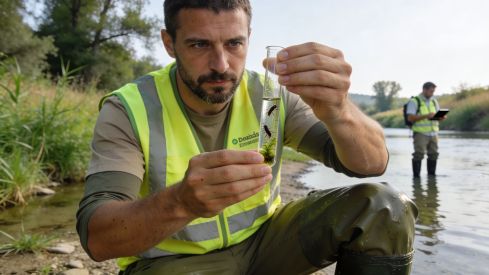
Dipsalut has reinforced during 2023 the control of simuliids in the regions of Gironès and Baix Empordà, with the aim of avoiding an uncontrolled increase in the population of these insects in the Ter river basin and its tributaries.
Intensive treatments in Salt-Girona and tributaries of the Ter
The first comprehensive treatment was carried out in early April. Subsequently, five more interventions were carried out until mid-August, covering the periods of greatest risk. In addition, in the Salt-Girona area, eight additional treatments were applied at critical points such as the Monars canal, the Güell river, the Onyar river in the Vinyals ditch between Celrà and Bordils, as well as in several tributaries of the Ter.
During the second quarter, the maximum annual larval density reached 61,334 larvae per kilogram of macrophyte in mid-June. This data reflects the moment of greatest biological pressure in the fluvial environment.
Increase of the most aggressive species and difficulties due to low flow
Technicians have detected a 620% increase in the species S. erythrocephalum, considered the most aggressive towards humans. This increase coincides with a low and constant flow of the Ter during the 2025 season, a circumstance that hinders the effectiveness of larvicidal treatments.
The control service uses a very selective biological larvicide, which allows it to act on blackfly larvae without affecting the accompanying fauna of the river.
Surveillance and monitoring in the demarcation of Girona
The Dipsalut program establishes surveillance systems to delimit the geographical scope of the spread of simuliids in the Girona demarcation. The main recipients are the municipalities of Gironès and Baix Empordà, especially in the areas close to the Ter and its tributaries.
About twenty years ago, the Josep Trueta hospital began to treat cases of very strong bites associated with these insects. Most of those affected were residents or visitors of areas near the river.
Financing and evaluation of results
The program is entirely funded by Dipsalut and contemplates both the monitoring of larval populations and the application of larvicidal products in the sections of Gironès and Baix Empordà.
At the close of each campaign, a detailed report is prepared on the actions carried out and the evolution of black fly populations in the different sections under control.