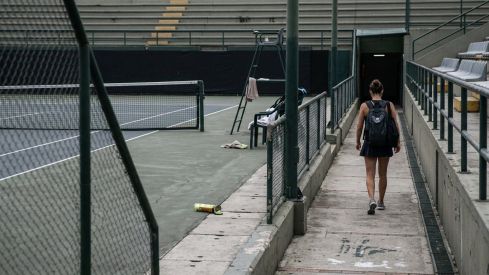
The Girona tennis player Marina Bassols has reported death threats received on social media after losing her qualifying match at the Bogotá tournament against Russian Anastasia Tikhonova. The player, 26 years old and currently number 203 in the WTA ranking, made the situation public this Sunday on her Instagram account, where she showed several of the messages she has received.
Among them is a particularly serious phrase. "I will murder you, I know where you live". Bassols also displayed other texts with threats and insults of a different tone, some of them explicitly violent, which he received after the meeting.
Public complaint by the player
The tennis player explained in a video shared on social media that these types of episodes are part of the daily life of many professionals on the circuit, especially on competition days. She assured that she speaks "from anger and sadness, but also being sincere from fear" and warned that a situation she considers inadmissible is being normalized.
"This is what most tennis players experience in our daily lives and especially on competition days. It is very serious" - Marina Bassols, tennis player
Bassols stated having received insults "of all kinds" and maintained that the number of messages reaching the players is "an outrage". She also rejected that the athletes have to assume others' frustration for the result of their matches.
"We go out to compete and give it our all. I am not responsible for anyone's bets" - Marina Bassols, tennis player
The player remarked that closing her profiles is not a solution and defended that platforms should be safe spaces to share content, support athletes and promote positive values, not channels to spread hatred or threats.
Messages of extreme gravity
In the screenshots he showed, expressions appear such as "How do you want to die?", "I will kill you 100%", "Be clear about it. You are dead", "I have paid a cartel to kill you" or "get yourself good life insurance and a lawyer, because I will kill you as soon as you return home". The content of these messages places the case in a scenario of particular harshness due to the level of verbal intimidation directed against the athlete.
Bassols wondered how far this situation would be allowed to go and if a tragedy would have to occur for someone to react and measures to be adopted. In his message, he also recalled that behind every player there is a person.
A problem that repeats itself in the circuit
The complaint by the Catalan tennis player occurs in a context of similar cases that other players have also made public in recent months, among them Lucrezia Stefanini and Panna Udvardy. The problem was already the subject of a report disseminated last year by the WTA and the International Tennis Federation, which demanded from the gambling industry a more effective action against the perpetrators of these abuses.
That report stated that 40% of the hate messages directed at female athletes came from bettors upset by the results. It also noted that 458 players were subjected to abuse or direct threats during the last year analyzed. Five female players concentrated 26% of the total identified abuses and 97 especially active accounts generated 23% of all detected messages.
Bassols' public exposure once again puts the focus on digital violence that recurrently affects professional tennis and that, in her case, has crossed the line of insult to fully enter into death threats.