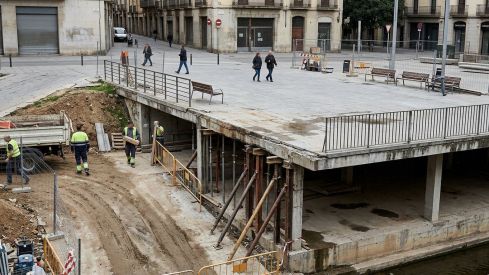
Girona City Council has resumed this week the emergency work under the Plaça Catalunya platform, a work that had been interrupted by the rise of the Onyar river. The works have been resumed once the riverbed has recovered its usual level and it has been possible to raise again the earth mound that allows access for trucks and machinery to the lower area of the structure.
The intervention will focus on about 120 beams out of the approximately 340 that are in the entire square, around 30% of the total. The objective is to shore up the pieces that are in worse condition so that the platform can continue functioning normally on the surface while gaining time before a larger-scale action.
A work of emergency without definitive solution
The deputy mayor and councilor for Ecological Transition and Urban Area, Sergi Font, has made clear that this phase does not entail a comprehensive repair of the structure.
"We are not curing her, we are putting crutches on her" - Sergi Font, City Council of Girona
Font has also explained that the recovery of the usual flow of the Onyar has allowed to reconstruct the provisional passage to access the lower part of the square.
"What has been done has been to rebuild the dike that allows workers to enter with the truck" - Sergi Font, City Council of Girona
The council insists that this emergency action does not solve the underlying structural problem. The work seeks to maintain ordinary activity in Plaça Catalunya, but the municipal government already admits that new interventions will be necessary in the future. Among the scenarios being considered are repairing the beams one by one or facing a complete demolition and reconstruction of the structure, a decision that the City Council places years away.
Term of three and a half months if there are no further incidents
The municipal forecast is that the works will last about three weeks for each of the water passage openings, with a global period of about three and a half months. If no new delays appear, the City Council calculates that the emergency action will be finished by the end of June.
"We foresee that more or less by the end of June everything will already be finished" - Sergi Font, City Council of Girona
Once this phase is finished, the local government maintains that the square will recover the necessary stability to develop usual activity on the surface. Even so, the municipal executive itself recognizes that the structure carries a deterioration that will force thinking about a large-scale intervention later on.
Traffic restrictions and changes in mobility
While the works last, restrictions are maintained to reduce the weight on the platform. The heaviest vehicles remain limited and some unloading points have been modified, including those for trucks linked to the Municipal Theater and those for school buses.
Additionally, the City Council has prohibited the parking of buses in the square, a measure that has forced the modification of the route of line L6. The municipal government will maintain these precautions until the intervention finishes.
"Until the intervention has not finished, these more precautionary measures will indeed be taken" - Sergi Font, City Council of Girona
Sant Jordi will change location in the square
The action will also have an impact on the celebration of Sant Jordi. This year it has been decided to change the space where more people will gather because the works will continue during those dates. The adjustment responds to the need to make the work schedule compatible with safety and the use of public space.
The debate is still open about the future of Plaça Catalunya
In parallel to the work under the platform, the municipal government maintains the participatory process to study the pacification of Plaça Catalunya and redefine its surface. The City Council is talking with residents, merchants, transporters and groups with reduced mobility needs to address the planned circulation changes.
The council wants to collect proposals before deciding how this central point of Girona should be transformed. The emergency intervention will allow to sustain the current use of the square in the coming months, but the debate about its fundamental reform remains open and conditioned by the real state of a structure that the City Council itself considers unresolved.