The regions of Alt Pirineu, Aran, and Ponent have experienced a sustained increase in temperatures, standing between 2.1 and 2.2 degrees above the historical average during the first quarter of the 21st century. This phenomenon, confirmed by Meteocat data, is accompanied by extreme weather events and changes in seasonal patterns.
Direct Impact of Rising Temperatures
Last summer, two particularly intense heatwaves were recorded in Ponent, one at the end of June and another at the beginning of August. According to climate change expert Víctor Resco, these "extreme summers" and shorter autumns are here to stay. The upward trend has accelerated since 2023, with temperatures exceeding the average for the reference period 1961-1990 by more than two degrees.
Resco warns that, if the current pace of fossil fuel consumption is maintained, the projection for the next 25 years is an increase of between 3 and 4 degrees compared to the historical average. Furthermore, the reduction in rainfall increases the risk of desertification in areas such as Ponent, where the lack of water resources is aggravated by the growth of the forest mass after the abandonment of crops.
Record of Extreme Phenomena and Adaptation in Agriculture
Between April and October, 19 extreme weather events have been recorded in Ponent, such as hailstorms or violent storms with strong winds, an unprecedented figure since records began. To mitigate the effects of high temperatures, the fruit harvest in Ponent has adopted intensive working days, starting harvesting at dawn to avoid the hottest hours.
Innovation and sustainability at ski resorts
The Catalan Association of Mountain Resorts (ACEM) has brought together industry experts for two days to analyze sustainability, innovation, and the application of artificial intelligence in the management of ski resorts. Aureli Bisbe, president of the Catalan resorts, highlights that AI will allow them to be "even more prepared for weather changes".
"Artificial intelligence will be key in the analysis of meteorological and consumption data to predict the needs of the seasons" - Aureli Bisbe, ACEM
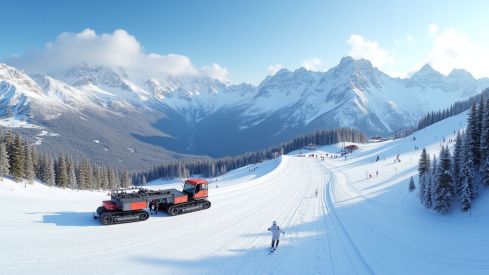
The use of state-of-the-art machinery allows for savings of up to 15% in snow production with cannons. Ignacio Sacau, a machine operator at Baqueira Beret, points out that "absolute optimization" is achieved for both the snow produced and that which falls naturally. Furthermore, geolocation technology facilitates more efficient resource management.
The machines can operate on slopes exceeding 45% thanks to winch systems, and the future points towards decarbonization through fuels like HVO, a hydrotreated vegetable oil. The snow, after being worked, requires 4 to 8 hours of rest to consolidate and harden properly.
Future Outlook and Pending Challenges
The acceleration of rising temperatures in Catalonia is confirmed as a challenge for the management of natural resources and economic activity in mountain and agricultural areas. Technological adaptation and innovation in sustainability are presented as key tools for facing the effects of climate change in the region
- Temperatures in Alt Pirineu, Aran, and Ponent between 2.1 and 2.2 degrees above average
- Record of 19 extreme phenomena in Ponent between April and October
- Up to 15% savings in snowmaking with advanced machinery
- Projected increase of 3 or 4 degrees in the next 25 years if fossil fuel consumption is not reduced