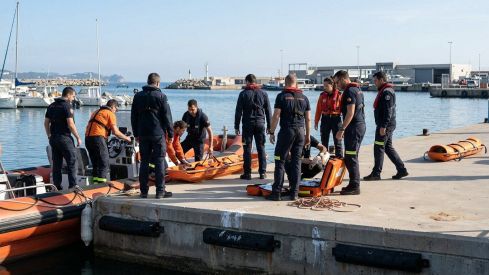
The Universitat de Manresa has launched the first specialized course in medical emergencies in aquatic environments in Catalonia, a training aimed at professionals who intervene in rescues and assistance at sea. The program seeks to adapt the health response to a particularly complex scenario, with practices in L'Estartit, in the municipality of Torroella de Montgrí.
The initiative arrives in a context marked by drowning mortality. In the last five years, about 200 people have died from this cause in Catalonia, a figure that places prevention and rapid intervention as two of the main challenges on beaches, ports, and bathing areas.
A month of training with internships on the coast
The course has a duration of one month and combines online theoretical content with three days of in-person practicals at the Club Nàutic de L'Estartit. In this first edition, a dozen students with profiles linked to emergency care have enrolled.
- Doctors
- Nurses
- Firefighters
- Police officers
- Rescuers
The practical sessions are developed with the collaboration of teams from the Red Cross and Salvament Marítim, with the objective of reproducing real intervention situations and transferring clinical knowledge to an open, variable environment and conditioned by external factors such as the state of the sea or the evacuation logistics.
The difficulty of intervening outside a controlled environment
"At sea we find ourselves in an environment that is not ours, with different rules" - Ramsés Martí, course professor
Martí has explained that the training wants to prepare professionals to act with safety and efficacy in an environment very different from the hospital or urban one. The objective, he has pointed out, is to bring the hospital's healthcare capacity closer to the emergencies that occur in the water.
"We want to bring the hospital closer to emergencies" - Ramsés Martí, professor of the course
The complexity of these operations is also highlighted by the rescue teams that usually work on the coast. Attending to a victim at sea forces one to adapt to an unstable context, where times and procedures cannot always be applied as on solid ground.
"These people have a lot of knowledge in controlled environments, but at sea it is a changing context, which has its particularities. Everything gets complicated" - Isaac Royo, volunteer of Salvament Marítim
The practices in L'Estartit allow precisely to work on that adaptation on the ground, with professionals from different fields sharing protocols and experience in a real environment. The university thus takes a first step to cover a specialization that until now did not exist in Cataluña and that aims to reinforce the response to aquatic emergencies.