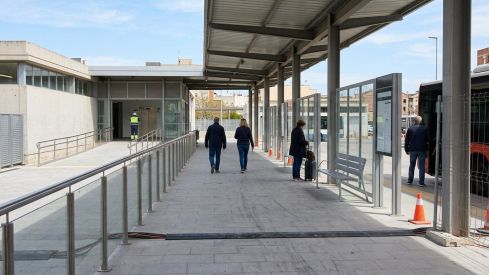
The Government plans to invest 10 million euros in 25 bus stations in Catalonia during 2026 as part of a plan to improve and rehabilitate these facilities. The Department of Territory, Housing and Ecological Transition has detailed that works in a dozen stations are already underway and that another 10 will begin in spring.
Girona concentrates the largest allocation
The regions of Girona will be the ones that will receive the most resources, with 3.5 million euros. From May, the bus stations of Figueres, Roses, Olot, Ripoll, Platja d'Aro, Lloret de Mar and Santa Coloma de Farners will be renovated. In addition, in Tossa de Mar, Sant Feliu de Guíxols and Cadaqués, action will be taken on the information systems.
Tarragona and Central Catalonia
The Camp de Tarragona will have 1.6 million euros. In this area, it is planned to tender this year the works at the Tarragona and Reus stations.
The same amount, 1.6 million euros, will be allocated to Central Catalonia. In this area, work is already underway in Manresa, Navàs, and Vic, while in Solsona they are expected to start in May.
Performances in Barcelona and the Penedès
In the Barcelona area, the investment amounts to 1.5 million euros. Works are already being carried out in the bus stations of Granollers, Caldes de Montbui and Terrassa. At Fabra i Puig station, in Barcelona, the start of works is scheduled for June.
In Penedès, the investment is around 800,000 euros. The works are already underway at the Vilafranca del Penedès station and the works in Vilanova i la Geltrú will begin in June.
500,000 euros for the regions of Lleida
In the regions of Lleida, 500,000 euros will be invested in the bus stations of les Borges Blanques and Balaguer.
"The Government has public transport among one of its main lines of action to facilitate citizen mobility, a mobility that is also sustainable" - Sílvia Paneque, Minister of Territory
The objective of these actions is to improve and repair elements of the stations to guarantee the maintenance of the facilities, modernize the service provisions and favor the comfort of users. The works include interventions on the pavement, the signage, the accesses, the urban furniture and the information systems, depending on the needs of each equipment.