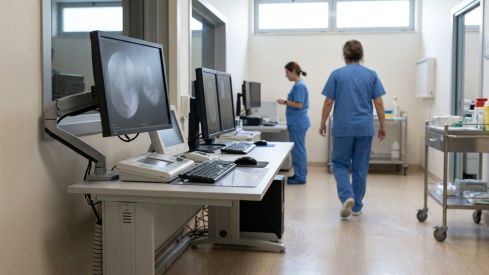
The Regional Ministry of Health will launch next June 20 an artificial intelligence program aimed at improving the diagnosis of three specific pathologies within the public health system. The initiative goes out to tender for 250,000 euros and will focus its application on the automated evaluation of prostate cancer, the detection of macular edema associated with diabetes, and the improvement of the diagnosis of ischemic heart disease.
Application in three clinical settings
The planned deployment seeks to reinforce medical image analysis in care processes where speed and diagnostic precision have a relevant weight. The three defined use cases are these
- Automated evaluation of prostate cancer
- Detection of macular edema associated with diabetes
- Improvement of the diagnosis of ischemic heart disease
The initiative will be developed in ImageDataSpace, a data space intended for research and the development of new products based on medical imaging. The project proposes using AI tools on this environment with the aim of improving healthcare and, at the same time, boosting innovation in health.
Decentralized infrastructure
"This project arises from the need to leverage the vast potential offered by digital medical images to improve healthcare and foster health innovation in Spain" - Sergas
The technical model foreseen for ImageDataSpace relies on a federated data space. This is a decentralized infrastructure that allows training artificial intelligence models without moving personal data from the providers' servers. In this case, those data remain in the systems of Sergas, which avoids their transfer during the algorithm training process.
One million images already processed
The public health system has already applied artificial intelligence to medical image processing in other care areas. Until now, one million medical images have been processed in emergencies and Primary Care, with uses linked to chest tests, musculoskeletal studies, and breast cancer. With this new program, Sanidade extends that journey to three new diagnostic lines with an activation already scheduled for June.